Showing posts with label Robin Hood. Show all posts

Saturday, December 7, 2013

A Little Poor… But A Lot of Fun


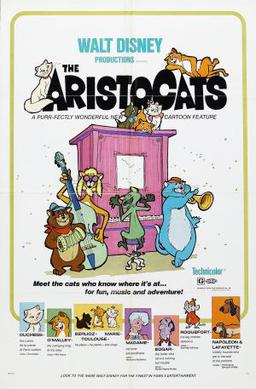
With the success of The Aristocats behind them, the once-groundbreaking Disney animation studio would continue to thrive. The suits realized that animation wasn't something that had to be sent packing; The Jungle Book was a record-breaking hit and The Aristocats kept the success streak going. However, The Aristocats also showed the suits that you really didn't have to set the bar too high. The Aristocats got mixed reviews upon release, but it still made money and was considered a good diversion for family audiences. The next feature would also resort to that kind of storytelling laziness.

Robin Hood evolved out of many attempts to tell the story of Reynard the Fox, a character who Walt Disney deemed unsuitable for a lead heroic role. After Walt's death in 1966, production on a Robin Hood film began and the studio decided the tell the story with an all-animal cast. This film is actually a classic example of this trope, one that Disney Animation will be revisiting for the upcoming Zootopia, it was also explored by DreamWorks in their Kung Fu Panda franchise. Art director Ken Anderson went all out, coming up with several great character designs, only for them to be watered down into the kind of designs you'd find in a Saturday morning cartoon. He actually cried when he found out that his works were turned into such by-the-books designs! In addition to this, Robin Hood would turn out to be one of the most cost-efficient films in the Disney canon, and not in a good way. The studio really cut the budget this time around, and in turn... It really affects the whole production, making it a very middling effort from the studio - both visually and narratively.
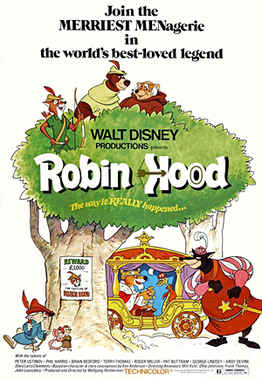

Fortunately, Robin Hood boasts a very appealing cast despite the streamlined character designs. Making Robin Hood a fox was a great idea from the start, and Brian Bedford (Tommy Steele was originally considering to voice the titular character) brings out his sly trickster demeanor. He's smart as a whip and he is good at giving the bad guys a run for their money, but he's also very likable. Little John is fun, but he's really a recolored Baloo - he's also voiced by the same voice actor, Phil Harris! It doesn't help that a lot of animation from The Jungle Book is recycled in this film, it just doesn't really set the character apart from the two-bit bum bear from Walt's swan song.


Also, aside from Phil Harris, Robin Hood's cast is half-American. There's quite a few British actors in the film, but a lot of the characters have Southern accents. So is this Robin Hood: Bayou Edition? Andy Devine voices the portly badger Friar Tuck. Roger Miller and the animators transform minstrel Allan-a-Dale into a country singing-and-whistlin' rooster. Pat Buttram voices the Sheriff of Nottingham, who is portrayed as a pudgy but suitably mean-spirited wolf. (Taking a birthday present farthing from a child? Cruel.) John Fiedler voices the sexton, a borderline tough-guy mouse, probably just to have Piglet's voice in there for the sake of it being there. This side of the cast clashes with the British cast, which is all well-picked.


Peter Ustinov makes Prince John the wimpiest of Disney villains, and one of the funniest. A bratty, whiny adult child who comically sucks his thumb when his mother is mentioned, he's a delight to watch. His banter with Sir Hiss (voiced by Terry-Thomas, and he even has Thomas' teeth gap!) is also hilarious, making up for what doesn't work in the film. These two are pretty much a riot, and it's fun to see a villain who cowers when the hero is swings a sword in his direction, a nice little change of pace. Monica Evans and Carole Shelley, after voicing the two silly geese in The Aristocats, return to voice Maid Marian and Lady Kluck. Maid Marian is pretty much a bland damsel-in-distress in many ways, Lady Kluck is spunky, loud and one tough chicken. She's one of the most enjoyable characters in the film as a result.

In addition to such an American-flavored cast, the film goes a very cartoony route. Robin Hood isn't trying to be a lavish, fairly serious fairy tale like Snow White and the Seven Dwarfs or Sleeping Beauty. Instead, it's trying to be freewheeling comic fun like The Jungle Book and The Aristocats. There's lots of goofy slapstick, no real dramatic tension and lots of anachronisms. During the archery tournament fight scene, Lady Kluck takes down Prince John's rhinoceros guards like she's playing football, complete with the University of Southern California fight anthem! It's a very bizarre moment, but yet it's so strangely amusing because the film doesn't even present itself as nothing more than a giddy full-length cartoon to begin with.

If one takes Robin Hood on those terms, they could enjoy it very much. It's not really a retelling of the classic legend, but just a fun romp based on some of the tale's elements. Like many have pointed out, it's really a good extended Saturday morning cartoon episode more so than a Disney animated feature, one that bests most of the Saturday morning cartoons made in the early 1970s. As a work of cinematic storytelling, it just falls flat because it isn't really trying to be anything more than just a comical cartoon adventure…


Robin Hood is essentially The Sword in the Stone all over again, oddly enough since both of them are set in the Middle Ages and came out nearly ten years apart. Robin Hood is a compilation of sequences, episodes really. It's all strung together, feeling incomplete and also a bit incoherent. The Sword in the Stone didn't have much a plot with a goal, neither does this. Robin Hood robs from the rich and helps the poor, that's about it, really. Now looking at the different sequences, they are competently-made and well-told sequences. Very entertaining and enthralling at times, too. But where's the center? Where's the heart? It doesn't really resonate.

The first thirty minutes of the film are a complete mess, with two "day in the life" exploits of Robin Hood and Little John supplying the levity and fun. But then we also get an inconsequential sequence where young rabbit Skippy loses his arrow and goes to retrieve it with his friends, thus meeting Maid Marian and Lady Kluck. The picture takes a while to really take off, but it starts coming together thanks to a great archery tournament sequence that comes in during the halfway point. This whole sequence is well-paced, the lack of music makes it exciting and there's some great inventive stuff thrown into the mix: Robin Hood's stork disguise is fun, Sir Hiss puts his head in a balloon and flies around like a helicopter, and Robin's attempt to undo the Sheriff messing up his final shot. All good stuff right there.

Then a really action-packed chase follows when Prince John shows that Robin Hood faked everyone out, making this whole section of the film even more exciting. From here until the climax, Robin Hood begins to start clicking. In fact, it starts to get really intriguing when Robin Hood carries out his most elaborate plot ever: Get all the money back, save Friar Tuck from being hanged and break the poor out of prison. Like the archery tournament sequence, there's very little musical accompaniment and it's actually pretty suspenseful - almost like the mice and key sequence from Cinderella. After all the build-up, we get a lot of fast action and this really great escape sequence that just gets bigger and bigger... Then it's all thrown out the window.

All of it.

After Robin Hood escapes the burning castle, Prince John has his last "mommy" freakout and chases a frightened Sir Hiss. Then the scene ends, and then the next morning comes ... Alan-a-Dale tells us that King Richard returned and "straightened everything out". Originally, there was going to be a sequence where King Richard enters the castle right after Robin escapes, angered at what Prince John had done in his absence. To save money, they cut this nearly-completed sequence at the eleventh hour. This decision only showed how low Disney had sunk at the time, and it was a move that truly hurt this film in many ways. Having that would've been the perfect capper to the climax, and it would've given the film's episodic structure something an ending, and a little bit of a center that it was so lacking. The return of King Richard should've been triumphant, considering the build-up, something that would've ended that climax with a real bang.
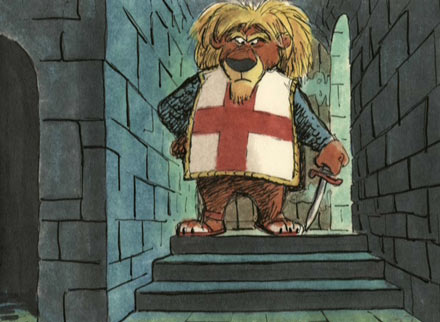

Alas, we didn't get that thus we have to be told what happened. Fine for a kids Saturday morning cartoon, but this is a full-length animated Disney production. Might as well not show the dwarfs chase the hag to the cliffside, just have them run after her and fade to black. Saving money by recycling animation from several Disney films for the bulk of the film is one thing, but completely cutting this ending is another. There's also an earlier storyboarded alternate ending where a wounded Robin Hood escapes the castle and Prince John hunts him down, but he is stopped just in time by King Richard. (This can be seen on both the Most Wanted Edition DVD and the recently-released Blu-ray.) Was the studio that low on money that they couldn't make a roughly 2-3 minute conclusion for the film? It takes such great build-up and soils it with an anticlimax... That's not how you resolve something, especially something big!

Had Robin Hood been made at another time in the studio's history, it would've been much better. This film wonderfully captures the situation that Disney was in at the time, and many animation historians have noted the many instances of traced animation in the film. I'm personally not a fan of it, as I feel that it doesn't differentiate these films from one another. Thankfully, this "recycle animation" thing was ditched after the 1980s (save for Beauty and the Beast's inexplicable recycling of the final Sleeping Beauty dance for that film's final seconds). It was something that producer-director Wolfgang Reitherman really latched onto, among other things.

Much has also been written about the quality of Woolie's work after Walt's death and during the Ron Miller era of Disney. He was actually ousted from The Black Cauldron during early pre-production. probably because of his "touches" to these films (Phil Harris, the Southern vibe), and the young animators especially hated the disco musical number that was in his early treatment of The Fox and the Hound. But Woolie really had a love for recycling animation, others however, didn't. Animator Milt Kahl angrily declared that the animators were "garbagemen", and proceeded to say some not-so-polite stuff about what they were doing to Disney animation. Newly-recruited Don Bluth (his second time at the studio) was also not happy with the direction Disney's animation wing was going... Major changes would ensue, of course.

Robin Hood would have to be right down there with Disney's 1960 featurette Goliath II when it comes to recycling animation. So much of the film is cut-and-paste, it even recycles itself! For instance, Prince John's rhino guards marching? You'll be seeing that a ton of times in the film, along with Alan-a-Dale's walking and whistling. The credits, like The Aristocats' credits, is composed entirely of scenes from the film, but without the backgrounds so that they don't spoil anything.

Technical problems aside, Robin Hood is hurt by its lack of a good resolution to such a good climax. It also fails to resonate. Maid Marian is a bland love interest, and she's one of the only Disney heroines that I'd call a shallow damsel-in-distress. To those who complain about how Snow White and Cinderella don't pick up swords like Mulan and fight others, why not get upset over this character instead? She always needs saving, and she's not that interesting to begin with! Robin and her have a brief but pointless "romance stroll" through the woods, accompanied by the film's weakest song and perhaps one of the blandest of Disney songs... Simply titled "Love". It's weird-sounding early 70s AM pop meets strings-heavy syrup, and I never remember much of the lyrics after each viewing.


The other songs, however, are actually pretty good. Where this film lacks in story and visuals, it completely packs a punch with the songs. All fun ditties in their own right, even if the Southern country flavor doesn't particularly fit in with Merry Old England. Roger Miller's "Whistle Stop" is intoxicating, "Not in Nottingham" is fairly dour but it works (it's used where it's needed, of course). "Oo-de-lally"? Fun, hummable. I also really love "The Phony King of England", despite the scene's rampant animation recycling. At least the songs serve a purpose here, and they help bolster the cartoony exuberance of the film.

Other than that, there is not much else to say. It's economic as hell, lacking in a good story and often falls flat with too much cutesy pap (the whole "lost arrow" sequence, I didn't even like that bit as a kid) and schmaltziness. It at least has something of a decent story compared to The Aristocats, and it doesn't plod like that one. It's surprisingly more engaging, but still very weak in structure and its scope is also limited by the low costs. Nottingham Forest looks more like the Hundred-Acre Wood than the forests in The Fox and the Hound. Some of the art direction just looks basic, almost TV animation-level. I understand that they had a budget, but this decidedly more minimalist style leaves one wanting more.

Robin Hood... Is that you?

Robin Hood opened in the fall of 1973 to generally less-than-enthusiastic critical response, but it was the biggest animated film on initial release back then. It only proved to Disney management that you could be ho-hum and still turn out a hit, even in the changing animation landscape. Yellow Submarine, Ralph Bakshi's first two films and Fantastic Planet only made this and the film before it seem dull. The re-releases of Walt's greatest films also made these two films pale in comparison in many ways. Luckily, a certain someone wanted to take action and would come to dominate a good chunk of the next feature... Don Bluth.

Despite its myriad problems, Robin Hood has always had a fanbase. The charm of the characters and humor is irresistible for many, even me. With all the problems I have with it, it's still fun to watch and I do find myself enjoying a lot of it. So... A poor-but-enjoyable movie? I guess so. In 1984, it would be the first of the "moratorium" Disney animated classics to be released on home video, and the release did sell very well (according to Disney). It seems like Robin Hood got a lot of popularity on video over the decades, given that this film does appeal more to children than it does to adults than most Disney animated films. Still, its video sales never got it any Platinum status or anything of the sort. But aside from the young, the film seems to have many older fans, too. There's just something about it that calls you to it... Heck, someone like director Wes Anderson must be a fan because he used "Love" in his brilliant Fantastic Mr. Fox!

Robin Hood in the end may not be a good film, but it isn't without merit. The film doesn't really aim to be a great classic to begin with, you can get that vibe easily from the first half hour or so. The film basically had the intentions - like The Aristocats before it - to give the audience, young and old, a fun time at the cinemas. Nothing more, really. It just wanted families to come in and leave happy. It's like a rather okay local amusement park, you get a kick out of some of the rides and whatnot but let's face it, it's not Disney World or Universal or Six Flags! Does it have to be? No, not really.

Robin Hood works well when taken on terms like that, it's decent, entertaining and memorable family fare. Its problems are quite glaring, but you can still have a good time watching it. Stacking it up next to the other Disney animated classics can be a bit unfair, as it's leagues below many of them. There could've been some good tweaks made in order to make this film much more solid.

"Robin Hood" is in the fourth tier of my ever-evolving best-to-worst Disney animated classics list. What are your thoughts on this Disney animated feature? Sound off below!

Saturday, July 28, 2012

The Dark Age? (Part 1)


The 1970s and 1980s are often regarded as the Disney “Dark Age” and a tough time for animated films in general, but were they really?

Both decades brought ups and downs for the medium, but people tend to focus on the negative aspects more than anything. Some of Disney's weaker films happened to be made during these times, but this isn't exclusive to the 1970s or the 1980s. Disney had their ups and downs during the much-heralded Renaissance, and had several hard times after that faithful period. I want to focus on a particular period, starting after the release of Walt Disney's posthumous The Jungle Book in 1967 and ending in 1986 with the release of Don Bluth's blockbuster animated smash, An American Tail.

While Disney was plugging along, other studios decided to take advantage of the medium like Walt himself did. Animated films were on the brink of losing the adult and teenage audience, and only had to rely on the family audiences to stay alive. While Walt made family films, he never made "children's films". His films appealed to adults as much as children, which is why they were so successful and still are to this day. With Saturday morning cartoons polluting the world of animation, more and more people turned their back on the art form and assumed that it was for children only. The films the studio released contrasted heavily with Disney's output at the time, which was shockingly bland and rote. Let's take a look into what the Mouse House was up to during the late 1960s and early 1970s, what else was around during that time...

~

Disney proved that they were without a clear direction after the death of Walt Disney in 1966 with their next feature. The runaway critical and commercial success of The Jungle Book convinced the studio that animated films could still be profitable and popular in an era of cheap child-oriented Saturday morning cartoons, so the crew began work on a film Walt gave the go-head to, The Aristocats. When the film was released in 1970, it underwhelmed the critics while family audiences flocked to see it. It was another financial success for Disney, and that’s what the suits wanted. The Aristocats essentially takes after The Sword in the Stone and The Jungle Book. It’s a carefree comedy with fun songs, silly situations and wacky characters. The Jungle Book used this tone to its advantage, and the result was an enjoyable film that was full of character. It had no problem in taking liberties with Rudyard Kipling’s books, but it was never tasteless or condescending towards the audience. The Sword in the Stone failed to make this style work, and instead fell flat on its face with an episodic story that had barely any structure, no real conflict or any form of strong drama. It was enough to get Walt to be more involved with The Jungle Book and more critical of story man Bill Peet, who ended up leaving during pre-production of that film.

The Aristocats is an awkward, uneven mix of both films. The conflict is there, but the idea of Madame Adelaide having her cats inherit her fortunes after she passes away is contrived and quite frankly, idiotic. The antagonist, Adelaide's sly butler Edgar, is not much to write home about. After all, it would be silly to not inherit anything while a bunch of cats will, and most likely outlive you. The love story feels like a reheated version of Lady and the Tramp, as the relationship lacks any real chemistry. Duchess (voiced by Eva Gabor) and Thomas O'Malley (voiced by Phil Harris) aren't as appealing as they should be, seeming like stock characters more than anything. The idea of the cats having to get home rings too similar to One Hundred and One Dalmatians. The Aristocats feels like it's on autopilot, trying to use what made those past films work, plus excessive cutesy cliches, and hoping they make for an acceptable diversion. It’s definitely more kid-friendly than what Disney had put out before. It was always one of my favorites growing up, and to this day, I have a sentimental affection for it.

One of the more successful things in The Aristocats are the songs, particularly the big number “Ev’rybody Wants to Be a Cat”, written by Floyd Huddleston and Al Rinkler. This sequence is a real treat, done with such verve, giving the often dull-looking film a splash of much-needed energy. The Aristocats’ visuals leave a lot to be desired, with such a mundane palette and a style that seems to be a regurgitated One Hundred and One Dalmatians, but without the edge or flair that distinguished that film from the other Disney classics. Everything about the visuals are by-the-numbers, passable but nothing spectacular. The Sherman brothers contribute three songs, the opening credits number sung by Maurice Chevalier, the childish and unnecessary "Scales and Arpeggios" and an unused song, "She Never Felt Alone". Why they cut it, I don't know... In the film, it would've worked and established how the cats meant the world to the lonely old widow. Terry Gilkyson's "Thomas O'Malley" is nice and upbeat, and it fits the character as much as "The Bare Necessities" fit Baloo.

Everything else crumbles: The non-existent story, the romance between Duchess and Thomas O’Malley, and the conflict. Even more shocking are its glaring inconsistencies and anachronisms. First of all, Scat Cat’s gang. The film takes place in Paris in 1910, yet one of his friends is a hippie cat with beads and glasses. From there, you can simply tell that the film is not trying to take itself seriously at all. Another friend of his is a Siamese cat, and one that’s a rather unflattering stereotype (“Fortune cookie always wrong!”). A Russian cat and an Italian cat make up the rest of the gang, and they all have great personalities, more so than Duchess and everyone else. Their scene is a highlight, but it’s possibly the only great scene that can be salvaged from the mess. Also, how do they know what jazz is? Jazz wasn't around in France in 1910, instead starting up in New Orleans (unless Scat Cat happened to be in New Orleans first and then somehow got to Paris). It just feels like a cheap excuse to have jazz music in the film, because swing music worked so well in The Jungle Book and certainly payed off. The rest of the narrative is padded out with comic relief and slapstick. Scenes with two geese and their drunken uncle have no point, only taking the cats back to Paris while trying to provide the laughs. When Edgar attempts to dump the cats off in the countryside, he is pursued by two goofy dogs with Southern accents. He loses his hat and umbrella to them, thus we get a lengthy scene where he goes back to their farm and gets back his belongings. These scenes are funny and well-timed, but amidst the sloppy narrative, they are inconsequential.


The Aristocats is ultimately too self-conscious, making for a romp that essentially plunders the last few Disney films in an attempt to lure in the family audiences, and it worked. The Aristocats would not be approved by Walt Disney himself, considering how he felt about The Sword in the Stone. Nonetheless, it was a big success that taught Disney one thing: "Keep making more films, but keep the budget low and don't try anything crazy. Audiences will love it just the same."

When The Aristocats was in production, two animated features made for a potential renaissance. George Dunning’s Yellow Submarine and a re-release of Walt Disney’s Fantasia...


Yellow Submarine, in addition to having a Beatles soundtrack, was a wildly experimental endeavor that mixed different forms of animation to elevate a surrealistic dream-like story where The Beatles travel to the magical land of Pepperland to outwit the music and peace-hating Blue Meanies. The plot was more than just a linking device for the numerous sequences set to the Beatles’ songs. Unlike The Aristocats and Robin Hood, Yellow Submarine’s narrative never felt half-hearted. It’s a tad episodic, but never aimless. At 90 minutes, it was certainly a bit longer than most of the Disney animated films given the song sequences, over fifteen Beatles recordings made the cut and some of them tend to divert from the story itself. Directed and animated with panache and creativity, they combine unpredictable psychedelic flair with an ethereal aura.

“Eleanor Rigby” serves as a tour of a dreary Liverpool full of rotoscoped humans and black-and-white photography that look sorrow and lifeless. George Harrison’s introduction combines filtered live-action footage and several colors while “Love You To”’s prominent sitar captures an Indian background, as Harrison was diving into the world of raga music during production. “Lucy in the Sky with Diamonds” is a purely wild psychedelic dance, while “Only a Northern Song” blends the pop art of Peter Max in a sea of confusion. Other sequences such as “All You Need is Love” advance the plot more so, as John Lennon sings it to the Dreadful Flying Glove and defeats it. Others, such as the wickedly wacky and madcap “Hey Bulldog” sequence tend to meander, but the film doesn't need to reach its climax in such a hurry.

Yellow Submarine is not thinking of plot. Delightful characters, abstract art, sharp satire and music are the name of the game. Yellow Submarine feels more in line with one of the Golden Age films, particularly Fantasia. The use of music and artwork to tell a story might not have been new in 1968, but Yellow Submarine reintroduced this concept to general audiences.


The success of the film carried over onto the 1969 re-release of Fantasia, where it was accepted as an art film. Disney marketed it as a head trip film for its 1969 re-release, knowing that it was surefire way to appeal to contemporary audiences. With that, the film finally turned a profit, something Walt unfortunately did not live to see. The success of Yellow Submarine and the re-release of Fantasia kicked off a new era for animation, as the 1970s were dominated with equally interesting and surreal efforts: Bruno Bozzetto’s Allegro non Troppo, Richard Williams’ Raggedy Ann and Andy: A Musical Adventure, Sanrio’s Metamorphoses and several others.

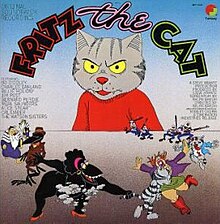
Yellow Submarine showed what heights animation could go to on a visual level, but two films showed what kind of content an animated film could try on: Ralph Bakshi's first two films, Fritz the Cat and Heavy Traffic. Both films used an animation style that was decidedly ugly and gritty, with dashes of unrestrained surrealism. Instead of telling universal stories fit for general audiences, they opted for more modern stories that reflected society. With its gore, sexual content and language, Fritz the Cat became the first animated film to garner an X rating from the MPAA. Its shock value imagery got people talking, but Fritz the Cat was praised for its social commentary and ambitions. Fitting in with the auteur movement of the 1970s, Bakshi's film was a very personal story in a modern setting. It was far removed from the fairy tales and classic stories that dominated the medium for the last few decades. Fritz the Cat wasn't the first "adult-oriented" animated film, but it was unlike anything audiences had ever seen before. In turn, it was an unexpected smash hit, especially for an independent release. His following film, Heavy Traffic, released in 1973, was another critical and commercial success. Both films would start a boom of sorts, of animation with shock value and content only suitable for mature audiences: Down and Dirty Duck, Heavy Metal, King Dick, Rock & Rule in addition to Bakshi's next few films. However, some of these films failed since they only relied on content rather than the story or the brains that made Fritz the Cat and Heavy Traffic successful.

Meanwhile, Disney was content with staying within the boundaries with their next feature, Robin Hood. Going a rather unoriginal route, the entire story was retold with animal characters. Like The Jungle Book, the characters would be heavily modeled after the celebrities who provided the voices, and the film had a rather eclectic cast for a story set in Merry Old England. A good portion of it is American, particularly of the country variety: Roger Miller, Pat Buttram, Andy Devine... Phil Harris portrays Little John, who is a dead ringer for Baloo, the corner-cutting only gets worse from there. The Disney studios were apparently so low on money, that Robin Hood was literally made on a shoestring budget of $1 million. Several scenes recycle animation from previous Disney features and short subjects, I even noticed this when I was young. Disney had been doing this for quite some time before Robin Hood, but the laziness is so rampant here that animator Milt Kahl called the animators “garbagemen”. A scene where King Richard returns to the kingdom was almost finished, but cut at last minute, leaving a huge void in the film’s final act. Sherwood Forest echoes the look of the Hundred Acre Wood more than anything, making for a rather bland-looking presentation of what should be a beautiful, dazzling forest. It’s devoid of any visual pizzazz or sparkle.

Instead of telling the story of Robin Hood in an epic manner, the film instead decides to yet again give us another Jungle Book-style comedy romp. Like The Aristocats, it’s definitely a winner with younger audiences, with its Saturday morning cartoon conventions. At times, it’s very witty and even entertaining as all hell. Like The Sword in the Stone, it’s just a bunch of episodes strung together by a non-existent story that goes nowhere. Then out of the blue, things start to get interesting. There’s an incredible amount of build-up during the film’s third act, as Robin Hood comes up with a clever way to steal all of the gold from Prince John’s bedroom without waking him while Little John frees the imprisoned citizens of Nottingham and saves Friar Truck from being hung. It gets very good, then a big chase occurs, things get exciting. All of it culminates with Robin Hood jumping off the castle and into the moat, surviving some arrows and then Prince John flipping out on his snake assistant, Sir Hiss. What happens next? Surely Prince John, Sir Hiss and the Sheriff all get what’s coming to them, right? No. Instead, Allan-a-Dale, the film’s narrator, tells us that King Richard returned and “straightened everything out”. This conclusion is a gigantic middle finger to the audience, and one can only imagine how it would’ve been had the animators actually completed the sequence where King Richard shows up right after the final battle.


Robin Hood contained the weakest story in a Disney animated film, one that had no direction and had an unsuitable finale. The conflict between Robin Hood and the authorities seemed to be muted in favor of pointless scenes, including those of a young bunny named Skippy and his friends. The archery tournament sequence is a highlight, but again, it feels like a mere episode. The banter between Prince John and Sir Hiss is quite hilarious, as Peter Ustinov turns the tyrant into an absolutely hilarious coward that would make Captain Hook blush. Sir Hiss, voiced by Terry-Thomas, only adds to the fun. The musical numbers are quite catchy, provided by Roger Miller, George Bruns, Floyd Huddleston and Johnny Mercer. The choice of artists certainly was more modern than any other Disney film, obviously to help the film appeal to contemporary family audiences instead of opting for something timeless. Their songs are certainly good, but most of them feel dated. Roger Miller’s “Whistle Stop” is all whistling like the title implies, and his sorrow “Not in Nottingham” feels like a 1960s country song. “The Phony King of England” resembles the bouncy zest and carefree flow of “I Wan’na Be Like You” and “Ev’rybody Wants to Be a Cat”, while also blatantly stealing animation from both scenes. “Love” has no punch, however, with its simple title and generic early 1970s MOR sound. When you think of Disney films, you may think of legendary love ballads like “Bella Note”, “Tale as Old as Time”, “A Whole New World”... “Love” is not one of those.

Don Bluth
New animators were brought into the studio during production of the film, enthusiastic young individuals who would become the next generation of classic Disney animators. One of them, however, wasn’t one of the young animators: Don Bluth. He had worked at Disney during the late 1950s and mid 1960s, only to return in 1971. Excited to be working alongside the Nine Old Men, the giants, Bluth was not impressed with what he was seeing in Robin Hood. He felt that the Disney animated features no longer had any of the charm that defined the classics. Despite what critics, animators or anyone at Disney thought of it, Robin Hood broke records once again and became the highest grossing animated film on initial release and one of Disney’s biggest hits at the time. This proved to Don Bluth that Disney no longer cared about what Walt would’ve wanted, it was all about profits. Plain and simple, Disney had went from the tree of fine family entertainment to an assembly line, just getting by.

Something had to be done at this point...

Part 2...