Showing posts with label Moving Forward. Show all posts

Friday, June 29, 2012

Moving Forward (Part 3)


Here in part 3, I take a look at Tangled, Walt Disney Animation Studios' 50th film (if you happen to go by the canon, that is). This film was notable for being Disney's biggest commercial success since the Renaissance, and one that got outright critical acclaim. But, is it deserving of the status of "Best Disney animated film in years?" Also, I take a look at Winnie the Pooh, the hand-drawn follow up to The Princess and the Frog.

~

Tangled
Directed by Byron Howard and Nathan Greno
Written by Dan Fogelman
Produced by Roy Conli, John Lasseter and Glen Keane
Released on November 24, 2010

Another project that was on and off at Disney for so many years, a serious attempt to actually get started on it occurred sometime towards the end of Michael Eisner’s regime. It was originally thought to be a Shrek-style film called Rapunzel Unbraided, and it was a project that just remained on the back burner until the new regime changed Walt Disney Animation Studios. The writers quickly dropped the original plot, involving two modern day teenagers playing the roles of Rapunzel and her love interest. It would not have worked.

Originally thought to be a revolutionary breakthrough for computer animation, the project would later shift to two directors Nathan Greno and Byron Howard, while original co-director Glen Keane (master Disney animator) was out. He was still involved with the recooked film, which went from Raounzel to Tangled due to Disney’s concerns over The Princess and the Frog’s box office performance.

Tangled comes off as two films much like Meet The Robinsons: 1). An irreverent comedy that sweetly pokes fun at Disney traditions, and not in a cynical and mean-spirited way like DreamWorks’ Shrek films. 2). A heartfelt film in the great tradition of classic Disney films. Meet The Robinsons had a hard time balancing two ideas, this one tries a bit harder and succeeds.

The rather gabby first act really establishes the relationship between Rapunzel (voiced by Mandy Moore) and Mother Gothel (voiced brilliantly by Donna Murphy). In the film’s first few minutes, Mother Gothel steals an infant Rapunzel from the king and queen of an unnamed kingdom and has her locked up in a hidden tower in the forest. Why? She wants Rapunzel’s magical hair to keep her young and beautiful.

Mother Gothel is manipulative of her, no doubt, but at the same time, it’s possible that Gothel actually has some form of affection towards her. Immediately, an emotional side of the story begins to take shape. At the same time, we’re treated to slapstick with Flynn Rider (voiced by Zachary Levy), a bandit who is just after valuables and Maximus, a palace horse. Actually, the two animals in this film don't speak, which makes them even funnier. Aside from Maximus, we also have Pascal, Rapunzel's chameleon. The comic relief all works very well and it adds fun to the story.

We are also introduced to the Stabbington brothers (voiced by Ron Perlman), who Flynn cons during the heist. They seem like minor characters at first, but they do play an important role later in the film along with the tiara that Flynn steals from the kingdom. Character development is more front and center in the film's second act, as we get to know more of Flynn's background. Rapunzel herself is a very well-written character. She isn't rebellious per se, she's curious about the lanterns that always appear on her eighteenth birthday, being sheltered her whole life. She stills worries about what Mother Gothel will say when she leaves the tower for the first time, which says quite a lot about her.

Alan Menken’s musical numbers seem a bit modest at best early on, though “Mother Knows Best” says a lot about Gothel’s character (Judge Claude Frollo in a way, but more flamboyant) despite being a bit silly. Rapunzel’s “When Will My Life Begin” is a great opening that is a bright, cheery number. Menken tries to recreate a showstopper with “I’ve Got a Dream”, a rather nonsensical song that everyone in The Snuggly Duckling (a tavern full of huge, intimidating brutes who are just silly, dreaming men at heart) sings with joy. It’s a little too silly, and it just feels like an attempt to give us another “Gaston”.

Tangled starts firing on all cylinders towards the end of the second act. After an uplifting dance scene in the middle of the kingdom (an actual dance, not one set to some pop song), we see just how saddened the King and Queen are when they plan to launch the lanterns in celebration of Rapunzel’s eighteenth birthday. It’s a silent scene, and for the better, and it wonderfully pulls the heartstrings. This leads to Menken’s “I See The Light”, the film’s best song and one that is a lovely tribute to the big love ballads in the Disney Renaissance films: “Tale as Old as Time”, “A Whole New World”, etc. The color, art direction and lighting on this scene is breathtaking.

When Rapunzel realizes how she’s been lied to all these years, it leads to a surprisingly tense third act that ends with a very sweet conclusion. The color scheme changes during Rapunzel confrontation with Mother Gothel, along with Menken’s score. The writers still attempt to throw humor into the film’s third act, but it’s never distracting. Tangled’s story is very solid, but it’s only held back by a rather inconsistent script. The aforementioned "two movies" problem does affect the film’s first act, and some of Menken’s work is rather flat. At times, the dialogue is all modern and that can get annoying. Eugene’s narration at the film’s beginning and end was rather unnecessary as well, because it treats the film as if it isn't serious. ("But don't worry! This is a fun story!")

Pretty as the animation is, it’s not the revolutionary style we were going to get. Instead, it’s an upgrade of the painterly look used in Bolt. It is a mere stepping stone, but it’s still nice. The character designs are appealing, but not fresh. They basically retain the typical appealing Disney look, but in computer animation. Rapunzel and Flynn's designs are very good, Mother Gothel's tows the fine line between menacing and motherly, with a dash of something over the top. The rest of the humans' designs aren't bland, but they're more on the typical side. Nothing unexpected here. The best designs were saved for Maximus and Pascal, being the film's show-stealers.

Tangled, like most of the recent Disney films, is another project that was saved from development hell. It's one that entertains like no other, and it comes off as a great crowd-pleaser. However, the story and script don’t match the likes of The Princess and the Frog, and even Bolt to some extent. The film somewhat struggles to keep a consistent tone, not knowing if it wants to be a fun comedy or something more in line with a Pixar film. It’s a bit on the safe side, but it has its heart in the right place.
B+


~
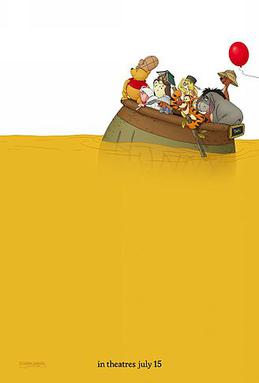
Winnie the Pooh
Directed by Stephen J. Anderson and Don Hall
Written by Stephen J. Anderson, Clio Chiang
Don Dougherty Don Hall, Brian Kesinger, Nicole Mitchell
Jeremy Spears and Kendelle Hoyer
Produced by Peter Del Vecho
Released on July 15, 2011

Winnie the Pooh was really nothing more than a gap filler for both Walt Disney Animation Studios and for corporate Disney. Disney apparently needed another Winnie the Pooh feature film to keep the franchise alive (why would they though?). Thankfully, John Lasseter took this under his wing and set out to make a film that was faithful to Walt Disney’s take on A.A. Milne’s classic stories.

At a brisk 69 minutes, Winnie the Pooh is well-paced and quick. It only takes two stories and turns them into a non-cinematic storyline, but one that is very charming and immediately likable. The voice cast is mostly different from the folks who voiced the Pooh characters for the last ten years, but they do a fine job nonetheless.

Nods to the original shorts are littered everywhere. Winnie the Pooh can almost be called a tribute film, yet it's one of the few films in this day and age that appeals more to children yet it does not pander to them like most of today's kid-oriented films. Winnie the Pooh is still a family film, as there is enough wit and charm to entertain anyone older than eight. It's very sentimental and nostalgic, tapping the right buttons.

Like the original shorts, it’s also a musical, with charming musical numbers and an affectionate re-imagining of the Winnie the Pooh theme song sung by Zooey Deschanel. The animation is virtually the same as the original shorts, it’s minimal and it resembles illustrations, but it's great to look at. At the same time, the animators throw in some surrealism to spice things up, with the chalk drawing “Backson” song scene and Winnie’s honey hallucination.

In the end, Winnie the Pooh is a pleasant film that’s very well-written. It’s not ambitious, being just a Winnie the Pooh film, but it’s a lot of fun and one that has a lot of passion put into it.
B+

~

A Grand Slam and a Big Bomb


After several years of early development and story changes, a definitive story took shape at Walt Disney Animation Studios. Rapunzel would continue Disney's classic tradition of adapting well-known fairy tales. For many years of course, this was going to be Rapunzel Unbraided, which ultimately would not have worked out. One look at this PreViz from 2005 is a great indicator.


Glen Keane and the crew behind this film would bring forth a revolutionary art style that made the film look like a Rococo painting come to life. Over the years though, the film would only have sheds of that, instead it would just improve upon the unique look used for Bolt. When finished, Disney kept touting that the budget for this film was $260 million, which would make it the most expensive animated film ever produced unadjusted. Disney most likely took the money spent on early development over the years (for example, Disney spent $25 million during development of Kingdom of the Sun, which later was reworked into The Emperor's New Groove, so that was added to the finished film's $75 million production budget) and added that to how much the actual film cost to make, which should've been around $120-140 million.

Before Tangled's first trailer ever appeared, changes happened at Disney. Rich Ross, whose background was in television, mainly the Disney Channel, was made Chairman of the Walt Disney Studios by CEO Robert Iger. He immediately fired everyone in the marketing department and brought in inexperienced young blood. Rapunzel was dropped, as the executives blamed The Princess and the Frog's underperformance on young boys avoiding a film with "princess" in the title. Failing to realize that it was bland marketing that caused it to underperform, they assumed re-titling Rapunzel to Tangled would solve the problem. This change deservedly got criticized, since the film is, at heart, Rapunzel.


Tangled was an awful title, and many folks knew it. Disney veteran Floyd Norman scathed Disney's decisions, and he was right to do so. Tangled's teaser trailer, which debuted in front of Toy Story 3, was an absolute disaster. With its pop music, teenybopper dialogue ("Best day ever!") and frenetic tone, this looked like a debacle in the making. The marketing, however, was aggressive. The film debuted on November 24, 2010, touted as the 50th Disney animated feature film in the canon.

Something happened... It opened with... $48 million at the domestic box office, a record for a Disney animated feature film! Critics loved it, and word of mouth caught on that this was a comeback for Disney, despite how good Bolt and The Princess and the Frog were. With Thanksgiving weekend giving it a boost, Tangled outgrossed all of the post-Lion King Disney animated features unadjusted. It took in $200 million domestically and $590 million worldwide, while also doing very well on home media.

While Tangled's success was great, it's also saddening at the same time. The two films that preceded it definitely could've done as well had they been backed by better marketing, since word of mouth elevated those films beyond their awful opening weekend performances. With that behind them, you'd think there would be some fanfare for the next animated feature, right? Think again...


Enter Winnie the Pooh, which was a fairly modest project that only cost $30 million to make. It would be a cheaper endeavor, one that could keep the Winnie the Pooh franchise going. The problem was, selling a Winnie the Pooh film wasn't easy. Ever since the Winnie the Pooh merchandising explosion of the early 1990s, numerous direct-to-video and theatrical spin-offs, alongside awful preschooler television shows that heavily pandered to the younger set, Winnie the Pooh seemed like a "kids only" thing from Disney despite the brilliance of the original short subjects.

Winnie the Pooh was obviously going to be just like those short subjects, so maybe it would be a slow burner at the box office. It was not likely. Disney's marketing department, for reasons unknown, decided to give it the barebones treatment. It debuted in Europe first in mid-April, and it did terrible business. The domestic release occurred on July 15, 2011, the same day Harry Potter and the Deathly Hollows, Part 2 opened. Now, Winnie the Pooh obviously wasn't going to appeal to the same demographic, but it could've. Here's why...

When an animated film grosses a lot, it shows that more than just families and children made them a success. Adults and teenagers play a big part in the success of the biggest animated films, and Winnie the Pooh could've gotten a decent chunk of that had it been marketed correctly and given a better release date. With that, it only opened with an awful $7 million, but... Word of mouth was good! It climbed to $26 million, but that made it the least-attended Disney animated film in years.


Like I said in the review, Disney could've avoided this and just left 2011 empty. The two stories used to form the film (originally, there was going to be five!) could've been divided into two short subjects. With that, they could've avoided the financial disappointment. Hand-drawn animation wouldn't have taken such a harsh blow, and maybe hand-drawn animation would really make a comeback much earlier. It was another marketing woe from Disney that hurt a very good animated feature...

Meet The Robinsons, Bolt, The Princess and the Frog, Tangled and Winnie the Pooh are the rebirth of Walt Disney Animation Studios, as the first film slowly started the Third Golden Age of Animation alongside Enchanted. These films were met with praise for the most part, and are seen as superior to what Disney was churning out every year. After The Lion King, Disney's animation wing fell victim to the executives who thought their "help" was going to improve the animated features. There were a few risky efforts that worked for the most part, but other films only turned people away from the studio as Pixar, DreamWorks and Blue Sky were offering the goods.

Disney executives, and DreamWorks' executives, were so quick to torpedo hand-drawn animation in 2003. DreamWorks' Sinbad: Legend of the Seven Seas tanked and Disney's Brother Bear underperformed. Finding Nemo, on the other hand, outgrossed the two of them put together by an extremely wide margin. It did so because it was far superior to those films, not because it was a computer animated film. Sure, computer animation was a novelty to audiences back then, but now that it's worn off, now is the time to re-introduce hand-drawn to audiences. Now is the time to remind audiences why Disney is a great animation studio, and shatter the whole "Pixar is great, Disney is bad" mindset.


These five films are already proving this slowly but surely, as Disney seems to be excited about promoting the risky Wreck-It Ralph. With its November release date, an appeal amongst the gamer crowd along with family audiences, and a satisfying trailer, they are looking to recreate Tangled's success. If it does well, then that's good... But that can't be a once in a lifetime hit. Frozen needs to repeat that success when that opens in 2013. The next planned film is Big Hero 6, which will be something along the lines of a blockbuster being based on a Marvel Comics series. That should be another critical and commercial success, if not something that'll be an easy sell to support the studio.

But more importantly, Ron Clements and John Musker's next film, a hand-drawn film that's reportedly going to be done the same style of John Kahr's revolutionary short film Paperman, needs to be even more successful in order to really kick things into high gear.
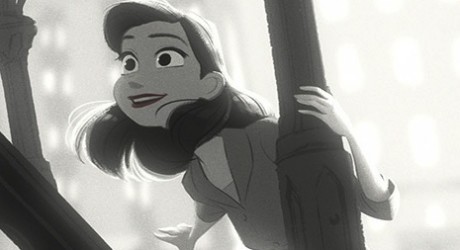
The future of Disney animation?

Paperman, which is going to debut in front of Wreck-It Ralph, will be no ordinary animated short film. The animation itself is a seamless blending of computer animation and hand-drawn animation, not for a sequence, but for an entire short film. According to various reports, this is how Ron and John's next film is going to look. This is apparently going to be what Disney will be doing for traditional animated features. Not only are they experimenting and trying something different, they are also breaking new ground for the medium. If Ron and John's next film is just like this, then it's not only going to elevate Disney's animated feature studio at the box office, but propel the medium to amazing new heights. You might say the other studios are going to try and emulate that.

It seems as if Walt Disney's dreams of advancing the medium are going to come true. The Disney studios almost got there, had Pinocchio, Fantasia and Bambi never bombed at the box office and shattered Disney's confidence in ambitious works. Over 70 years later, as the studio is no longer controlled by executives or people who weren't creative, they have the opportunity to take daring risks again. With the success of Tangled behind them, now is their chance to really soar.

Can it happen?

~

From Part 4 onwards, I'll take a look at the DreamWorks' films that were released in the last four years starting with Kung Fu Panda. Do you personally believe that Walt Disney Animation Studios is heading towards a new Renaissance? Do you think the Third Golden Age of Animation has been going on since 2007? Or do you think that it has yet to start? Which of these upcoming Disney films are you looking forward to? Which of the five films do you consider the best? Sound off!

Wednesday, June 27, 2012

Moving Forward (Part 2)


In the first part of "Moving Forward", I took a look at two Disney animated features that marked the beginnings of the comeback of one of the greatest American animation studios of all time after years of disappointing audiences and critics alike. Those two films were Meet The Robinsons and Bolt, which I reviewed while also taking a look at how they performed and what the outcome was for both of them.

Here, I take a look at Disney's The Princess and the Frog, the successor to these two films and the studio's return to hand-drawn animation, a medium they ditched six years prior to its release.
~

The Princess and the Frog
Directed by Ron Clements and John Musker
Written by Ron Clements, John Musker and Rob Edwards
Produced by Peter Del Vecho
Released on December 11, 2009

With the changes made at Disney in 2006, hand-drawn animation was going to make an immediate comeback amidst the glut of computer animated films. Fox’s The Simpsons Movie and Disney’s own Enchanted were the first stabs, along with the Goofy short film How to Hook Up Your Home Theater. The Princess and the Frog marked Disney’s full return to hand-drawn animation, and the animated musical format, which they hadn’t done since Home on the Range.

At first glance, The Princess and the Frog (terrible title, should've stayed as The Frog Prince) seems like an attempt to recreate the much-lauded Disney Renaissance. It has a love story, a big bad villain and big production numbers. It actually isn’t, it’s just an attempt to make a good, heartfelt musical in the vein of classic Disney musicals, from any decade of Disney's history. The Princess and the Frog does not go for some epic plot like most of the Renaissance films do. In fact, it’s a simplistic plot that’s very character-driven. Tiana (voiced by Anika Noni Rose) and Prince Naveen (voiced by Bruno Campos) are both the polar opposites, who both learn about the most important things in life on their journey.

Tiana is the textbook example of a workaholic, chasing a seemingly impossible goal. She puts her job and hard work before everything, rejecting spending time with her friends or getting married and raising a family. Her mother Eudora (voiced by Oprah Winfrey) wants her to follow in her deceased father’s (voiced by Terrence Howard) footsteps. Tiana believes she is, by fulfilling his dream. A hardworking man he was, he still made time for his family, something Tiana fails to realize. At the same time, Prince Naveen is cut off by his family for being a lazy schmuck. His valet, the whiny Lawrence (voiced by Peter Bartlett), tries to ram that point home by telling him to either marry a rich woman or get a job. The Maldonian prince (fictional location) doesn’t seem to care, he just wants to live life.

Enter Dr. Facilier (voiced wonderfully by Keith David), a voodoo witchdoctor whom they make a deal with. He's not a big bad powerful villain like some of the Disney Renaissance villains (Jafar and Scar, anyone?), he already has some power, which proves to be his undoing. He has no relationship with the main characters, he's just a con man. He's a threat because of Naveen and Lawrence, he's not a threat from the get-go. A recreation of the Renaissance films? Think again. Facilier grants them a better future, but it ultimately backfires on Prince Naveen. He’s turned into a frog, whereas Lawrence is magically transformed to take on the appearance of the prince, as long as the prince’s blood isn’t used up in the voodoo charm. Tiana meets the frog prince on a balcony during a masquerade ball. The prince tells her that a kiss will undo everything, but it only turns Tiana into a frog. The two find themselves lost in the Louisiana bayou, as the second act goes into full throttle. The two embark on a quest down the bayou to get to a voodoo lady named Mama Odie (voiced by an outrageous Jenifer Lewis) with the help of Louis (voiced by Michael-Leon Wooley), a jazz enthusiast alligator and Raymond, a Cajun firefly (voiced by voice actor veteran Jim Cummings).

At first, these two come off as the typical Disney sidekick characters. The ones that are there to provide comic relief. There’s nothing with this, but Disney had so many annoying sidekicks in the 1990s that popped up in serious moments to lighten the load for children that weren't really necessary. In this film, they aren’t. They’re important to the story, which does get a bit muddled towards the end when the gang meet Mama Odie. Despite some messy odds and ends, the third act climax solves this all without haste. Everything locks together perfectly. Supporting this colorful story are a screenplay that never panders or pulls any punches and musical numbers that ooze with confidence. Randy Newman's New Orleans jazz-infused songs soar, and his score captures the setting of the film quite wonderfully. You can feel the energy that went into this film, it’s quite exciting to experience.

Take “Down in New Orleans” for example, it’s fast and directed with such verve, it pulls you right into the story. Dr. Facilier’s surreal production number, “Friends on the Other Side”, is reminiscent of the outright madness of “Pink Elephants on Parade” from Dumbo mixed with a psychedelic voodoo nightmare. Tiana’s dream song, “Almost There”, is set to a beautiful Art Deco style scene. The animation style shifts, much like it did for the “Barking at the Moon” montage sequences in Bolt.

The other songs are satisfying, though some are better than others. The thumping zydeco tune “Gonna Take You There” (sung by Ray) is a bit flimsy, but Mama Odie’s “Dig a Little Deeper” is bombastic and exciting. “When We’re Human” is like “I Wan’na Be Like You” from The Jungle Book in the Louisiana bayou, it’s a lot of fun. Ray’s love song to a star, “Ma Belle Evangeline”, serves as a love ballad for Tiana and Naveen, much like “Kiss The Girl” and “Tale as Old as Time”.

While moving the story forward with songs that define the characters and situations (not production numbers for the sake of having them), the writers tried incredibly to balance a lot of subplots here, especially the ones concerning Dr. Facilier, Lawrence and Charlotte (Lottie), a wild and obnoxious debutante who is close friends with Tiana (voiced by a hyperactive Jennifer Cody). This is why the story does get a bit inconsistent towards the end of the film, but everything is wrapped up nicely.

The Princess and the Frog’s only other problems are some of the similarities to the older Disney films, but it never feels like they are trying to revive the same old hat tricks. Instead, they’re breathing new life into these Disney traditions. Also, the film does have some unnecessary slapstick, mainly a very cartoony scene involving three swamp hunters, which starts out funny but turns sour when the violence emulates a Warner Bros. cartoon. Slapstick is fine in animation, but when it really goes against the realism of a film, it's a problem.

Best of all is the animation, combining the vivid beauty of films like Bambi and the Golden Age films with the softer style of the 1950s Disney films like Peter Pan and Lady and the Tramp, while also having the style change (“Almost There”) and adding other surprises along the way, such as flashes of Tim Burton (particularly with the scenes with the friends on the other side), Richard Williams ("the cards... The caaaards!") and others. The bayous look lovely, much like the forests in Bambi and Snow White and the Seven Dwarfs. The design of New Orleans itself is pretty to look at, as said before, it has a Lady and the Tramp feel given the turn of the century setting.

The character animation shines, always vibrant and energetic. When it comes to hand-drawn films from Disney, always expect the character designs to be great. The characters move swiftly, and they all have unique designs. Tiana and Naveen may draw similarities to other Disney couples, but then you got Dr. Facilier whose sleek design suggests his snake-like nature. His shadow is creepy, resembling something out of a Tim Burton film or The Haunted Mansion. Lawrence comes off like Cogsworth, but his design is actually rather sinister. Lottie's design is off the wall, going along with her crazy character. Mama Odie's design is hilarious. The frog versions of the two protagonists are fine, but a bit lacking. Louis and Ray? Great designs, especially Ray. You can tell the animators had a field day here.

The Princess and the Frog feels like the studio has gotten their confidence back after years of executive interference. Directors Ron Clements and John Musker essentially delivered the classic Disney musical (after all, they directed Disney's The Little Mermaid, which felt more like a genuine Disney film than the few that came before it) with traces of the other Disney films from every era, but with fresh new twists. It’s a real treat.
A-

~

The Second Coming of Disney?

The Princess and the Frog was chosen for the studio's first hand-drawn film since Home on the Range, most likely because Disney hadn't adapted a classic fairy tale for years. It was announced that this would be the return to hand-drawn animation as far back as July 2006, when projects like American Dog and a Rapunzel adaptation were still in the works. Of course, these two projects would become Bolt and Tangled. When early concept artwork was shown sometime around early 2007 (with the title The Frog Princess), it got criticism from all across the board, directed at the character designs, the setting and the title itself. Changes were made, but the writers kept the idea of having the film be about an African-American princess and it being set in New Orleans (being John Lasseter's favorite city). Originally, Alan Menken was going to write the songs, but the job was given to Randy Newman instead. Disney legends Ron Clements and John Musker (The Little Mermaid, Aladdin) were to direct the film, with Peter del Vecho as producer.


The first trailers began popping up in 2008, but the marketing kicked into full gear a year later. It's too bad that the film's trailers and TV spots didn't sell the movie as an event (I didn't want to see it back when it came out, the ads made the film look lame). Despite the fanfare, positive critical reception and its wonderful performance at the two theaters in both Los Angeles and New York respectively (on Thanksgiving weekend), it took in a disappointing $24 million on its opening weekend. Disney apparently felt that releasing the film a week before competition like Avatar and Alvin and the Chipmunks: The Squeakuel was a good idea. So, with it disappointing, what happened after that?

People liked the film, despite families being suckered in by the dreadful Alvin and the Chipmunks sequel, they went to see it as the holiday season ended. It crept up to $104 million domestically, not bad for a film that opened so low. It grossed less than Bolt though, and worldwide, it only took in $267 million, against a $105 million production budget. The executives blamed everything on the film having "princess" in the title. However, Disney was at least happy with how it did in the long run (add huge merchandising sales to that). Production on a hand-drawn animated film every two years was a go, rather than being every year. Soon after, a hand-drawn Winnie the Pooh film was announced for 2011.

The Princess and the Frog did well on Blu-ray and DVD, deservedly, as it found new audiences. Like Bolt and Meet The Robinsons, it's one that people are going to discover over the years.

So that wraps up Part 2. It was originally going to include Tangled and Winnie the Pooh, but those were saved for Part 3. The Princess and the Frog's qualities and the fact that it was the big return to hand-drawn animation (not financially, of course) for Disney called for its own part.

Monday, June 25, 2012

Moving Forward (Part 1)


It's my firm belief that two studios out of what I call the "big three", Walt Disney Animation Studios and DreamWorks Animation SKG, have been stepping up their game in terms of storytelling and writing. As such, these two studios are still doing well alongside Pixar. Other studios in the past six years or so have came and went, with only a few studios actually staying in the playing field (Blue Sky, Illumination and Sony Pictures Animation).

With Disney's Wreck-It Ralph and DreamWorks' Rise of the Guardians hitting theaters this November, I felt that I would review the films that I personally believe began their "uphill streaks". With Disney, I believe things got better with 2007's Meet The Robinsons. For DreamWorks, I believe they got better with 2008's Kung Fu Panda. So here we go, part one, where I take a look at Meet The Robinsons and Bolt.

~

Meet The Robinsons
Directed by Stephen J. Anderson
Written by Jon A. Bernstein, Nathan Greno and Michelle Spritz
Produced by Dorothy McKim and John Lasseter
Released on March 30, 2007

When an adaptation of William Joyce’s A Day with Wilbur Robinson began pre-production at Walt Disney Feature Animation (prior to being renamed Walt Disney Animation Studios), the studio was slowly plummeting to its demise in the wake of the computer animation fad and the critical success of Pixar's films, followed by DreamWorks' successes. Disney’s then recent films (Brother Bear, Home on the Range) disappointed many, and it seemed as if all was lost for the studio that was once one of the crown jewels of the world of animated features. The executives felt that switching to computer animation would solve all these problems and put them back up against the heavies. They announced that hand-drawn animation production had been phased out, and the studio would enter the computer animation world with Chicken Little in 2005. To them, traditional animation was dead, along with DreamWorks. It wasn't dead, people just avoided those poorly-written films.

Of course, then-CEO Michael Eisner stepped down. Disney bought Pixar, as they were close to losing them, and with that, John Lasseter had a lot of things revised. The A Day with Wilbur Robinson project underwent several revisions, and the result? A rather inconsistent film that was a sign that Disney was going back to good story-telling. Instead of doing what the other non-Pixar companies were doing (stupid romps with pop culture jokes and juvenile toilet humor), they opted for a simply good film with a good message. Meet The Robinsons’ biggest problem is how the two versions are balanced. A lot of the sugar rush, zany antics of the original project were kept since it was too late to undo most of this. It isn’t pandering or insulting, it's never only funny to younger audiences, but going against the more heartfelt, Pixar-like tone of the revised story, it makes everything seem a bit awkward.

The story is very heartfelt, and the characters are all very likable with cute designs. The film’s antagonist, the Bowler Hat Guy, is a hoot. It’s a very nice plot with some wonderful characters. It’s all well done and well told, but the two tones constantly battle each other. This was something the writers tried their best to overcome, and for the most part, the sugary side works. Sometimes, however, it gets tiring. There’s lots of “random” humor that would be more in line with what some high schoolers may joke about. Other bits are out of place. Fortunately, the film takes some time to wind down, despite the talky script.

When Disney entered the computer animation field, Chicken Little didn't look too bad, but it seemed to look similar to the more cartoony computer animated films produced at the time such as DreamWorks' Madagascar and Sony's Open Season. Meet The Robinsons goes for a more Pixar-esque look, and it's very colorful. The vision of the future is a bit saccharine, but it has a child-like wonder to it with a dash of Tomorrowland. The characters are instantly appealing, with googly designs. Only Lewis and Wilbur look normal, everyone else only adds to the setting and tone of the film. The art direction does take a shift for the film's third act climax, and the Bowler Hat Guy does look sinister at times. Visually, this is a very appealing film that works alongside the story.

It was nice to see this amidst the bland CGI films that preceded it in 2006, with only a few examples sticking out. It goes to show that the animators cared and wanted you to love the look of the film. I can't say the same about some of the other computer animated films that polluted the market at the time. Meet The Robinsons may not be overtly ambitious, but it is a pretty good film that has a bit of trouble picking a mood. Luckily, the writers do their best to use the humorous side to their advantage. It borders on tearjerker in the film’s closing minutes, and the idea of Walt Disney’s “Keep moving forward” quote being the core of the story was a lovely bonus, though it is pushed a little too much onto the audience.

In fact, had Disney solved their management issues much earlier (say around 2003 or 2004), Lasseter and the crew could've essentially made Meet The Robinsons even better and eliminate what really wasn't working and keep the tone consistent. That said, this is a very John Lasseter-esque film. It has the heart, the sincerity and the storytelling that defines a good Disney animated feature. If only they didn't have such little time to overhaul it, it would've been the first return to form, but it's still amazing that they were able to take the mess and turn it into a satisfying film in a matter of months.
B-

~

Bolt
Directed by Byron Howard and Chris Williams
Written by Dan Fogelman and Chris Williams
Produced by Clark Spencer and John Lasseter
Released on November 21, 2008

Like Meet The Robinsons before it, Bolt began life as a project that was problematic and was in need of an overhaul. Fortunately, John Lasseter and the crew at Walt Disney Animation Studios were working off of something that already had some strengths. The project was originally American Dog, the next big film from Chris Sanders (Lilo & Stitch), a quirky and risky story that ultimately suffered from story problems.

With him out, Lasseter had the project overhauled. Instead of working off of a goofy, pandering film (the early version of Meet The Robinsons), they were working off of something that was already something a little more serious. However, Bolt is much simpler than Chris Sanders’ original story and goes for a traditional route. This was enough to scare off most Disney fans, but the film turned out to be better than expected despite the skepticism. It isn't the quirky, daring film that Sanders envisioned. Instead, it's a modest but well-told effort that's one that you can sit back, relax and enjoy. Like Meet The Robinsons, it's just plain good. This doesn't have the trouble of balancing two ideas, though.

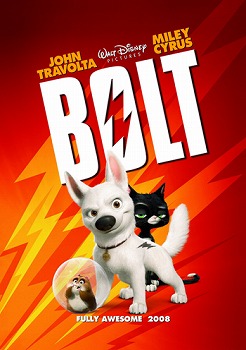
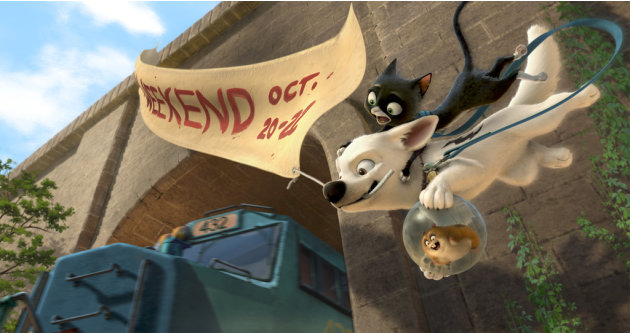
Our leads are likable, Bolt (voiced by John Travolta) is essentially a canine version of Truman Burbank from The Truman Show. He believes the show he’s the star of is real, as the editors and crew make sure he believes so. When he experiences the outside world, he is with a street-smart cat with a rather sad past named Mittens (voiced masterfully by Susie Essman) and Rhino (voiced by a hilarious Mark Walton), a hamster who is obsessed with Bolt’s show. These three leads are already very likable, while the supporting cast appears from time to time. Bolt’s owner Penny (played by an okay Miley Cyrus, obviously phoned in to sell tickets to the Disney Channel teenybopper crowd) is somewhat important in the first act, but she’s not in it as much as the advertising lead people to believe. Other characters that populate Bolt’s television world are a nice poke at the entertainment industry.

With that, Bolt focuses on what makes the films of Pixar so good: Heart. Bolt is someone you root for early on, but halfway through the film, we see that we are in the middle of a touching buddy comedy much like the original Toy Story. It never feels overtly derivative, just similar. There are other elements here from other films, but it’s these charming characters and wit that elevate the film. The screenplay, however, is a bit flat.

There is some cringeworthy dialogue here and there, but it’s mostly under control. The film's funniest jokes (particularly the scenes involving Rhino) are absolutely hilarious, so it mostly knocks it out of the park in the comedy department. It isn’t a masterful screenplay by any means, but one that dutifully supports the story. Our characters shine here, and the heart is right in line with a Pixar film. Combine this with crisp animation and you’ve got a winner. The animation did break some new ground, as the art direction takes on a painterly look. It was the first stepping stone in Disney Animation’s quest to find a style that will effectively blend both hand-drawn beauty and computer animation (see John Kahrs' upcoming short film, Paperman). On top of that, we also get flat animated map montage scenes set to "Barking at the Moon", a wonderful scene where Bolt, Mittens and Rhino see the sights across the country.

Bolt is essentially classic Disney, but in computer animation form. It's not daring or up to Pixar's levels, but it's a refreshing break from what Disney had put out before it. Gone were forced jokes, humor that pandered to kids and wildly inconsistent writing. Bolt, like a Pixar film or Walt Disney's films, is for adults, children and everyone else. It's simply good old fashioned entertainment with surprises along the way.
B+

~

Stepping Stones

When John Lasseter got on board at Walt Disney Feature Animation, he had a mess on his hands. A Day with Wilbur Robinson looked like it was going to be another disaster from the studio, coming off of the critically panned but commercially successful Chicken Little. With that, he was going to make sure that the studio would return to their roots and make good films again after disappointments like Brother Bear and Home on the Range. At the same time, he had the studio's name changed to Walt Disney Animation Studios, a much more suitable name. The release date was moved from fall 2006 to March 30, 2007.


Though there wasn't enough time to really overhaul the project, the crew did what they could in such a short timeframe. The Bowler Hat Guy was made into a much more interesting, and threatening villain. He was also given his sidekick, Doris. The ending was significantly changed to become much more effective, and the sequence where the villain gets a dinosaur to chase Lewis was added. That scene would become the core of the marketing in the United States.

The marketing sold it as a silly comedy, like Disney's marketing department tended to do. True, Meet The Robinsons is a wacky comedy at many times, but it's also a heartfelt story. The marketing failed to establish this, whereas a superior Japanese trailer got it right. Meet The Robinsons had a hard time at the domestic box office upon release. The marketing probably reminded audiences more of Chicken Little and the annoying animated features released in 2006. The general belief was that Disney stopped making good films since the Renaissance, but that doesn't explain how Chicken Little did so well. Perhaps it left a bad taste in audiences' mouths, combined with the trailers for the film.

Reviewers weren't very enthusiastic about it, but some did praise the deeper themes and the emotional side of the story. It opened with a rather disappointing $25 million, but something happened... This happened to every Disney animated film since then... It spawned great legs thanks to good word of mouth. Meet The Robinsons quietly climbed its way up to $97 million domestically, though that was still much less than what Chicken Little made. The executives probably weren't too thrilled about that. Worldwide, it took in a modest $169 million. It was a bit of an underperformer. Disney's live action/animation hybrid, Enchanted, outgrossed it significantly.

By 2007, people became more choosy with big release animated films. This is why something good like Sony Animation's Surf's Up had a hard time at the box office, looking derivative of certain other animated films despite being pretty original. People normally attend the Pixar films, and even Pixar's entry for the year posted a low opening despite the incredible word of mouth it got. It ended up grossing less than the dreadful Alvin and the Chipmunks domestically. It was a weird year, coming off of 2006, a very weak year for animation.

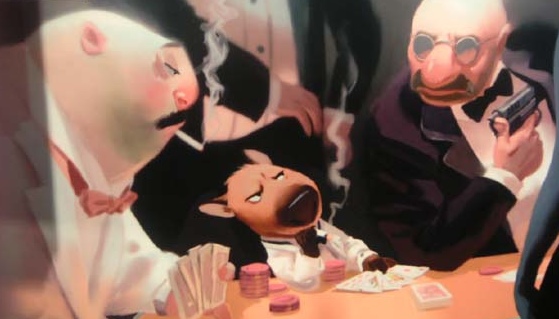
After finishing Meet The Robinsons, the next Disney film was going to be American Dog, which would be a much more serious return to form. Problems arose around December 2006, when Chris Sanders' story wasn't working. American Dog, much like Sanders' own Lilo & Stitch, was quirky with character designs that weren't your typical Disney character designs. The story involved Henry, a smoking and drinking canine star (you won't see that in a Disney film nowadays given their surrender to the anti-smoking craze at the time) of a James Bond-style TV show who believes everything on the show is real. He winds up lost, miles away from home, where he meets a one-eyed cat and a radioactive rabbit. They're looking for homes, but Henry is still deluded.


Sanders rejected Lasseter's notes, and things ultimately did not work out. Lasseter noted his talent, but he felt that the story needed work. A screening at the studio went over badly. Chris Sanders was out and the story was overhauled immediately. Lasseter kept the dog TV star being deluded, but changed the show to an action-packed story where the protagonist (renamed Bolt) is a super dog. The characters were radically redesigned. The one-eyed cat became a regular cat who doesn't trust humans. The radioactive rabbit would be replaced by Rhino.

The story was simplified, but Lasseter didn't want this to be a dud. He made sure that it had the heart, the wit and the sparkle that define the Pixar films. It's no surprise the story has similarities with Toy Story and Cars. It feels like a Lasseter film. Chris Williams and Byron Howard became the new directors of the project. The animation wouldn't be like the other films on the market, as the film introduced a painterly look that gave a traditional animation quality to the film's backgrounds.


Bolt wasn't easy to sell from the start. The Disney brand name was toxic, as their animated films hadn't caught on at the box office amidst the Pixar, DreamWorks and Blue Sky films. With the success of Enchanted however, Bolt could change that. The animation community was already upset over not getting Sanders' film, and the marketing sold it as a derivative, generic film. Something we've seen before. There was no punch to the marketing, which, in a DreamWorks fashion, kept telling us that John Travolta and Miley Cyrus were the leads in the film. The posters gave off an Incredibles vibe. The marketing was uninteresting and lazy.

Opening on November 21, 2008, it was going up against a certain film that was obviously going to be a huge hit. Bolt only took in a rather disappointing $26 million on its opening weekend, despite great critical reception. Then, it got excellent word of mouth and pulled a 4.3x multiplier. It climbed its way to $114 million domestically against all odds. Worldwide, it took in $309 million for its final total. However, this gross was less than Chicken Little and Enchanted. The film could've done better with a bigger opening (it's also upsetting since DreamWorks' inferior Madagascar: Escape 2 Africa made more than twice that amount on its opening weekend just two weeks earlier) and better marketing that worked alongside the word of mouth. It didn't happen, and this return to form was lost in the shuffle.

Bolt found new life on Blu-ray and DVD, but it could've been a much bigger success in theaters. More and more people are experiencing it, so maybe one day people will look back on this film and see that it was one of the building blocks that would lead to Disney's comeback.

In part two, I'll take a look at Disney's return to hand-drawn animation, The Princess and the Frog!