
I asked this question last summer... Are we going through a new Disney Renaissance? Or not? At the time, I felt... Yes. We are, and that it started with The Princess and the Frog. That was then, what do I think now?
Come to think of it, I think the term "Disney Renaissance" is kind of flawed. Of course, the real Renaissance referred to the great art movement in Europe, an era of innovative art, new ideas and many other great things. It was all at a time when it was big, when it was popular. The Renaissance was called what it was because it spread like wildfire all across Europe. Likewise, there was a renaissance in rock music in the 1960s: Experimentation, growth, success, new ideas that were unheard of in music. Now, the "Disney Renaissance" refers to the period when Disney animation became popular again. It was really a product of a greater happening in film history - The Second Golden Age of Animation, which began before The Little Mermaid was even put into production or green lit.
It is true that Disney animation grew in popularity at a rather rapid rate at this time. The Little Mermaid's $84 million take in 1989 was impressive for an animated feature and it was good for a film in general, but Beauty and the Beast sat alongside 1991's giants, Aladdin topped them all and The Lion King became 1994's biggest film at the worldwide box office and still one of the biggest of all time. You could say the 1989-1994 period was a Renaissance...
In technical terms, you could say it was a Renaissance as well. The Little Mermaid made use of computer generated imagery, but so did the three films before it. Mermaid's biggest innovation was perhaps the first ever use of CAPS, but The Rescuers Down Under was the real breakthrough here. It was the first film done completely in that format, and it allowed the animators and creative team to bring back effects like the multiplane camera. It did more with pure CGI, trying to mesh it with hand-drawn animation unlike what we saw in films like The Great Mouse Detective, Oliver & Company and The Little Mermaid where the animators traced over photocopies of the computer-generated images.

However, in The Rescuers Down Under, the traced over CGI (such as McLeach's monstrous bushwhacker truck) looks better than the pure CG imagery (New York City skyline, the Sydney Opera House), but this was an admirable first attempt to combine pure CGI images with hand-drawn art without making them look hand-drawn. Beauty and the Beast took these ideas further, with a dazzling Rococo ballroom that meshes almost perfectly with hand-drawn Belle and Beast. Aladdin's Cave of Wonders produced mixed results, but The Lion King has the incredible stampede sequence. The use of CGI and the integration of it continued to grow and go through its ups and downs, even after Tarzan... But most of the advancements were being explored during this period.
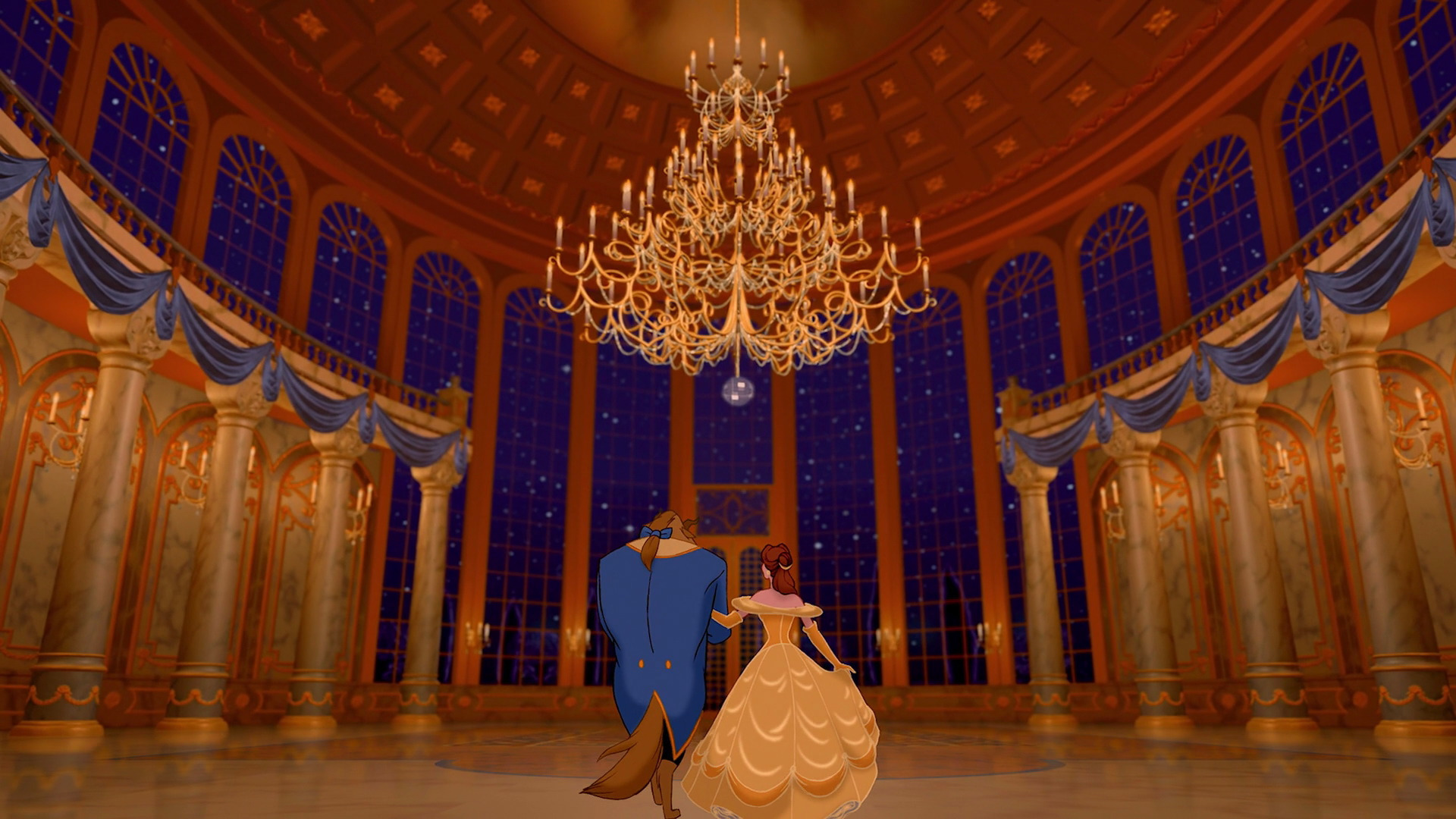
Quality? Well here's where I get iffy about the whole "Disney Renaissance" label (even though I use it from time to time)... The Little Mermaid, Beauty and the Beast, Aladdin and The Lion King are all very good films, but do they really try anything new? As far as I'm concerned, The Little Mermaid is a hark back to the Golden Age films like Snow White and Cinderella, but at least its story isn't a complete retread of those films' ideas. Beauty and the Beast, Aladdin and The Lion King however, are a bit on the formulaic side. Walt's films weren't, they were all unique and different. Some were even radically different than others (Fantasia is certainly no Cinderella, and Cinderella is definitely no Bambi), the 1990s Disney films feel like they are basically following Mermaid's basic template:
#1. Broadway/pop chart-topper musical numbers that consist of the love ballad, the villain song, the showstopper tune and the "I Want" song...
#2. Good vs. evil story with a love story.
#3. Has to have a cutesy sidekick in it, just for the sole purpose of making the films appeal to toddlers and selling Happy Meal toys. See the behind the scenes woes of Pocahontas for a good example of this. (hint, "If I Never Knew You".)
Not a terrible thing, per se, but certainly a far cry from what Walt was doing. It'd be okay if Disney used this formula for a film every once in a while (minus the pandering), but using it for film after film wasn't the risk-taking Disney should be associated with. The model was to make one film a year, but Jeffrey Katzenberg went about this in a flawed manner: Faster and cheaper. Cheap shouldn't apply to big event Disney animated films, though the budgets got bigger starting with The Lion King.
I also feel that the 1990s films, like example #3 of the formula, try too hard to please children. Walt's films didn't do that, as they took the audience seriously. I think the three rules of the formula are what deflated the Renaissance/hot streak. Adults are a big audience for these films, contrary to popular belief (kids are not the "target audience" of a Disney animated film, and never were), and films like Pocahontas, I believe, scared them off. At the same time, I think people just got tired of same ol' same ol' by that time. Hercules certainly didn't feel any different from the films that preceded it. It became cool to knock Disney for their formula, and it's part of the reason why Shrek was such a big hit. (Ironically, that Disney formula is a thing because of Jeffrey Katzenberg.)

Anyways, the "Disney Renaissance" is simply that time when Disney was huge and popular. Of course, when that supposedly ended in 1999, other animation studios became popular: Pixar, DreamWorks, Blue Sky... The Renaissance for Disney was said to end before the millennium even started...
So, a new "Renaissance"? Well, I don't necessarily think it's a new "Renaissance" per se... I consider the old Renaissance to be a "big era" of sorts. I would say Golden Age, but I usually use the term "Golden Age" to refer to all animation, not just Disney, but you can say 1989-1999 was the studio's own little Golden Age. But see, I think differently. From The Little Mermaid to The Lion King, it was a streak of good films. To me, Pocahontas ended that, but Hunchback was great! But then there was the enjoyable Hercules and the problematic Mulan, but the pretty good Tarzan followed that. The post-1999 films were certainly more experimental, regardless of how they all turned out. It was overall a good and successful era for them. I think Disney had their own Golden Age from 1928 to 1942, but that's another story.
I think this era is a new Golden Age for Walt Disney Animation Studios. When did it begin? In 2008, with Bolt, the first film completely produced under John Lasseter, the first from the fixed studio...

Of course, I have a great deal of respect for Meet The Robinsons. Lasseter did what he could with that film, as it was going to be an absolute disaster. Thankfully, half of it is great, focused and certainly not misguided. He literally steered the ship away from a whirlpool, and firing Chris Sanders from American Dog was an unfortunate happening... But from the way I see it, it had to happen. Bolt is essentially a building block to a better future for Walt Disney Animation Studios. Their reputation was rock bottom after Chicken Little, and Lasseter felt that Sanders' ambitious film couldn't go through at that rate.
It's a very rocky issue with the animation community, but I think Bolt is fine for what it is. Yes, I would love to see American Dog in any possible way, but I understand that the film was most likely riddled with issues and it would've perhaps been an unwise business decision to start production on it with the state that the story was in. Delaying it wouldn't have helped either. That being said, I take Bolt for what it is and I understand why we got this instead of Sanders' film. Lasseter was trying to rebuild Walt Disney Animation Studios reputation, and he had to sacrifice riskiness for the time being for the 2008 release, and then the two films that would follow. I'm sure that Lasseter probably would want something like American Dog to be made, but the timing just wasn't right.
That being said, Bolt may have been on the bland side in terms of the presentation, but it packed a very solid story with a great amount of heart, memorable characters and the good mix of laughs, emotional parts and pure fun. It was a laid-back road movie, and it may not have taken any great risks, but it on its own terms, it's a delightfully well-made film. However, I personally see sheds of what's to come in that film... The Bolt television show sequences are action-packed, reminiscent of the The Incredibles' great action sequences. They're pulled off well, and there's a brief bit towards the end with alien spaceships. Now those were designed well and I can see Disney doing an entire space film like that... In fact, they are!

The Princess and the Frog and Tangled are based on fairy tales, so I think Lasseter had a plan all along... I call this Phase 1 of the new Golden Age. Consider...
Lasseter turned the risky American Dog into the safe Bolt, and followed that up with two fairy tale adaptations that were not far removed from Disney's other fairy tales for a reason, methinks. He basically wanted to win audiences back, audiences who were left cold by Walt Disney Animation Studios' last couple of efforts, and the salvaged Meet The Robinsons most likely wasn't going to start bringing the crowds back in. (Though if you ask me, the bland paint-by-numbers marketing kind of held that film back from doing well at the box office.)
Phase 1 ended with Winnie the Pooh in my eyes, that project was gap filler. A new film based on the character had to be made for some rights reason, so Lasseter had Walt Disney Animation Studios make a good Pooh film rather than have DisneyToon make a bad cash-grab film. (Like we needed another film like Piglet's Big Movie or Pooh's Heffalump Movie?) Plus, 2011 was empty at the moment with King of the Elves set for fall 2012, and Reboot Ralph in spring 2013. Of course, we all know that didn't exactly happen.
But to me, Bolt, The Princess and the Frog and Tangled tread familiar ground and don't take any wild risks. Lasseter's game plan was to make a string of easily marketable films that would do well in the long run (i.e. Frog and Tangled being about princesses, merchandise), and Walt Disney Animation Studios did not slack off in that department. All three films were met with critical praise, Bolt and Frog did decently at the box office while Tangled was the big hit Disney Animation has been waiting for.
So now... We are in Phase 2. (Yes, Marvel is most likely in your right head now...)

Wreck-It Ralph, as I've said many times before, is more akin to something like Atlantis: The Lost Empire or Treasure Planet. It's not a fairy tale nor is it something you'd expect from a Disney animated film. It's about video games, it features settings that you wouldn't expect from a Disney film and in terms of the presentation, it's just different and a real breath of fresh air. That was one of the main reasons I was so stoked about it early on. But the writers and crew married these ideas to a very strong story that barely missed a beat, and one that packed the usual Disney heart and humor. On the other hand, Atlantis and Treasure Planet were risky and ambitious, but they were botched by suits who knew nothing about animation. Wreck-It Ralph gets to be what it wants to be, and as a result, it's such a fantastic film. It was a critical hit, audiences liked it, its loss at the Oscars even inspired a massive albeit misguided backlash. Disney Animation was finally allowed to make the great, risky film they wanted to make a decade ago.

Now, this autumn, Disney goes back to fairy tales once again with Frozen. Many skeptics argue that they are trying to recreate Tangled, which is something I myself was concerned about very early on. But having learned about the story itself, I don't think that'll be the case. Instead, I think it'll resemble Tangled in the way Cinderella resembles Snow White. Cinderella is not a rehash of Snow White, it's just a great story in the vein of Walt's first film. Plus, they are both fairy tales, of course there will be similarities. I think Disney will make fairy tales every once in a while to keep things going. Fairy tales are associated with Disney, so while experimenting, they can still give audiences the familiar fix with films like Frozen and Giants. It's like their top meal on the menu, they can't just stop doing that. At the same time, they look to entice audiences with new kinds of stories. Maybe one day, people will associate big action films - among many others from adventure films to thrillers to dramas - with Disney Animation, rather than just fairy tales and animal stories.
But the good thing is, they don't want to follow a formula. It's not like the 1990s anymore where the writers and artists had to obey the rules. The Princess and the Frog and Tangled are very different in tone, and their stories and structures are both different too. Frog has a big bad villain who toys with dark magic, Tangled has less powerful one that's manipulative. Frog is mostly classical in its dialogue and mood, Tangled is a little more modern and snarky. One involves a lot of magical elements, the other doesn't as much. Frog's musical numbers are big and Broadway-esque, Tangled's are quieter and small. I'm sure Frozen will be similar to both, but different at the same time. The basic plot is already different.

On the other hand, Disney will be trying something new with every other film. Big Hero 6 is something I probably would've never expected them to do ten years ago, adapting a Marvel comic (a lot of good came out of that acquisition, now did it?) that's very much like a manga. Imagine Disney doing a computer animated film that resembled Japanese anime... We're in for a real treat with this one, and Disney will have no problem marketing it since it'll automatically appeal to the demographic that the suits have been chasing for the last five years. It won't be an ordinary superhero film, as the film's team consists of a robot and a man who can transform into a Kaiju. It's set in a stylized city that's an already clever mix of Tokyo and San Francisco, and will probably have lots of sci-fi and action elements. This won't be a diet Incredibles, that's for sure. It's looking to be Disney Animation's first ever anime. That only hints that we'll see even more experimentation in the far future.

Zootopia will take us to a world where it's inhabited by human-like animals only, an extension of that trope that we've seen in countless animated films and cartoons - from Disney's own Robin Hood to DreamWorks' Kung Fu Panda. The concepts and ideas revealed at D23 earlier this month already show the gargantuan amount of potential that this film has, plus the whole framing story leading to a giant conspiracy plot already sounds intriguing. This ain't no Beauty and the Beast! Moana will take us to a Polynesian setting, and its story will most likely enthrall and intrigue. I like it when Disney attempts to look into different cultures for fantasy stories. Films like Pocahontas and Brother Bear, even if the finished films didn't turn out too well. At least there's great ideas there, from Pocahontas' "one with nature" aspect (which I felt should've really been explored) to Brother Bear's great spirits elements (which I felt they went all out with). Disney should do more with this kind of thing, but apply it to an excellent story. Maybe Moana will do just that.
If King of the Elves ever gets back on track, which I'm sure it will in the future, I can see that being a very big, epic fantasy with a touch of quirkiness. Big Hero 6 and Zootopia already seem different and out of Disney's comfort zone, and again, Disney Animation manager Andrew Millstein said that risk-taking is now a go thanks to Wreck-It Ralph's success, and that film's director Rich Moore added that the next slate films will open people's minds up to what a Disney film can be. That statement alone excites me. King of the Elves can be something like The Black Cauldron, except better. I think Disney Animation can pull off something big like The Lord of the Rings, something with compelling fantasy worlds and epic battles. Here's hoping director Chris Williams can get it off the ground soon.
Dean Wellins has had that "teenage space race" film - as Honor Hunter of Blue Sky Disney puts it - in the works for a while, and I can only imagine why it hasn't gotten off the ground yet. Disney Animation and an outer space, sci-fi setting would make for something truly amazing. I just hope that can get the greenlight soon, Honor Hunter seems to think that it'll be the studio's fall 2018 release. The Mickey Mouse film that Burny Mattinson confirmed a while back could be that as well, since Mickey turns 90 by that time... A Mickey Mouse movie would have to really deliver on all fronts as well, since it's the first proper feature-length film based on him. He's an icon, so they'll probably go all out with something amazing.
Now aside from the storytelling of these films, what about advancements in technology and the medium? Well, Bolt was the first Disney film to experiment with a new kind of computer animation - the painterly look. Bolt's art direction had the feel of a painting, and the computer animated characters and objects themselves blended with that. Tangled took this even further, as that had a traditional animation-style coating to it. Frozen is an extension of that, and Giants is rumored to take that style even further.

Then you had Paperman, which was pulled off with Meander. This shows that traditional animation really is alive and well at Walt Disney Animation Studios, and it's been rumored that Moana will be the first feature-length film done in this style, unless Giants does it first. It'll take computer animation to new heights while also differentiating the studio's work from the competition, so maybe people will stop calling Disney's computer animated films Pixar productions. And best of all, it'll keep hand-drawn alive in some form.
Going back to Millstein's "uncorked" comment, I think Wreck-It Ralph started Phase 2 for a reason. Unlike the four films before it, it was the big risk. The test to see if audiences would go see a Disney animated film that wasn't like the usual, and boy did it pay off. Now the game plan is to keep trying new things, like Walt would've done, whilst also visiting the Disney traditions every once in a while.
In all, I think we are going through a new Disney Golden Age. You can call it a Renaissance, but looking back on the Renaissance, I see it as more of a period of good, successful films. Just a solid Golden Age. If I did consider it a Renaissance, then I'd consider this a Renaissance as well. Of course, this opinion may be radical, but I consider this era that's coming to be the real Disney Renaissance in addition to just being a Golden Age. The so-called "Disney Renaissance" to me was just a successful Golden Age for them in terms of their success and their consistency of delivering good to above average films. But this coming era looks like Walt-era Disney reborn with a bite.
Nowadays, Disney is making films with great writing, but will also tackle different genres, themes, settings and stories much like their Emeryville comrades have. The Lasseter era of Disney has only gotten warmed up in the last 5 years, and now with Wreck-It Ralph behind them, they can truly take off.


