Showing posts with label Insomniac. Show all posts

Tuesday, April 23, 2013

A Boatload of Potential


I've been thinking about this sort of thing for a while. What if the movie industry were to try adapting video games into animated films?

An animated film based on Insomniac Games' long-running and successful video game series Ratchet & Clank was just announced today complete with a promotional teaser! Sony is apparently really confident in this, as it's already on track for a 2015 release. Rainmaker Entertainment (Escape From Planet Earth) is teaming up with Blockade Entertainment to produce this computer animated adaptation of the series.


I really liked this trailer. It's a fun irreverent deconstruction of animated movie trailers that'll sure get the laughs. I certainly thought it was hilarious, but this trailer and the film itself are not what I'm going to discuss. Instead, I'll discuss what this film means for the animation industry and video game movies in general. If this film goes over successfully in 2015 then I think we'll see a new frontier in both animation and film adaptations of video games...


Up until now, many major Hollywood films based on video game franchises were done in live action. I felt that live action severely limits things for some of these video game adaptations, one example being the Mortal Kombat films (that, and poor writing). I always wanted to see an animated Mortal Kombat film that was brutal like the games yet had cool action. Animation could show off the powers that the kombatants have while also making characters like Shao Kahn or Goro believable. Super Mario Bros. is another disaster, Mario and live action simply don't go together. Only a few adaptations were fine as live action films, like the Tomb Raider films and Prince of Persia: The Sands of Time. Unfortunately, a lot of these films just weren't good and lacked what made the source material work.

Now take a look at Disney's Wreck-It Ralph. While the film isn't based on a pre-existing video game, it has thrilling video game-style action and excitement, it does everything better than any of those live action films listed above. That's the power of animation, it could pull off what several live action films couldn't in that one film. Video games are animated, so animated films based on video games would work out so well. It is a massive risk, but I'm happy to hear that Sony is willing to take it. Ratchet & Clank also can't be done as a live action film, no way.

Now with all that being said, what could happen if this were to go over well? What if Ratchet & Clank is a box office hit? Suits will approach video game movie adaptations in a new way, one that actually works! Animated films based on video games could really be a big help to the current American animation industry, as many of these films could be adult-oriented and get audiences to see animated films that aren't family-friendly or fall into the G/PG range. Plus, there's a lot of great franchises to plunder. Ratchet & Clank is only the beginning!

I'm not saying that all video game movie adaptations should be animated. A film based on Halo or Gears of War could work perfectly in live action with the right director and screenplay, but animation is good for something like Ratchet & Clank. I don't know why this wasn't thought of earlier, because there are several video games that would make for great animated film adaptations: Super Mario Bros., Sonic The Hedgehog, Jak and Daxter, The Legend of Zelda, Mega Man, Sly Cooper... The list goes on.

What do you think of the upcoming Ratchet & Clank film? Do you think it will work out? Or do you think that one isn't necessary? Should animated films based on video games be considered? Or not?

Sound off below!

Monday, March 25, 2013

PSone Nostalgia: "Spyro the Dragon" (Part 2)


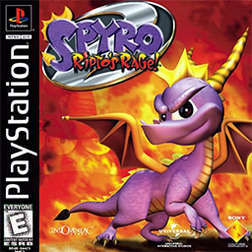
Here we are again, PSone Nostalgia! In the last part of this three-part review, I took a look at the 1998 PlayStation classic, Spyro the Dragon... Now, I'll be taking a look at the sequel to the impressive PlayStation game... Spyro 2: Ripto's Rage!

In part one, I took a look at Insomniac Games’ Spyro the Dragon. The fantasy adventure about the young purple dragon was the developer’s breakthrough title and functioned as a sort of brother series to Naughty Dog’s Crash Bandicoot series. Both companies were close friends. For example, in the first Spyro, there’s a playable demo of Crash Bandicoot: Warped. In Warped, there’s a playable demo of Spyro. Even when both developers moved onto other projects, there would be some crossovers and references would be made. (In 2004’s Crash Twinsanity, Spyro makes an amusing cameo appearance.)

All of this aside, Spyro the Dragon was a massive hit and a bestseller. It immediately put Insomniac on the map and everyone loved the purple dragon. The game was no cheap attempt to one-up Mario or Sonic, much like Crash Bandicoot. That orange marsupial immediately caught on with gamers, and so did the purple dragon. So of course, a sequel was on its way for release in fall of 1999 – just one year after the first game was released. Again, this was no different from Crash Bandicoot and its sequel. (I know, the Crash comparisons are getting irritating!)


Like Naughty Dog’s 1996 game, Spyro the Dragon did have its fair share of problems. In the first Crash Bandicoot game, it was the controls, the save system and a few other things that plagued what was otherwise a good game. In Spyro the Dragon, it was the easy difficulty level, the short length and the lack of mini-games and different challenges. When Naughty Dog created Crash Bandicoot 2: Cortex Strikes Back, they took the flaws from the first game into consideration and made lots of improvements. The controls were far better, you could save anytime and more variety was added: Crash could use jet-pack in some levels while other times he could ride a jet-board on the river levels. They did the same for the third and final installment in their series, adding even more ways to play. Insomniac did just that for Spyro 2: Ripto’s Rage.

One of the first noticeable improvements is the story. What’s the story?

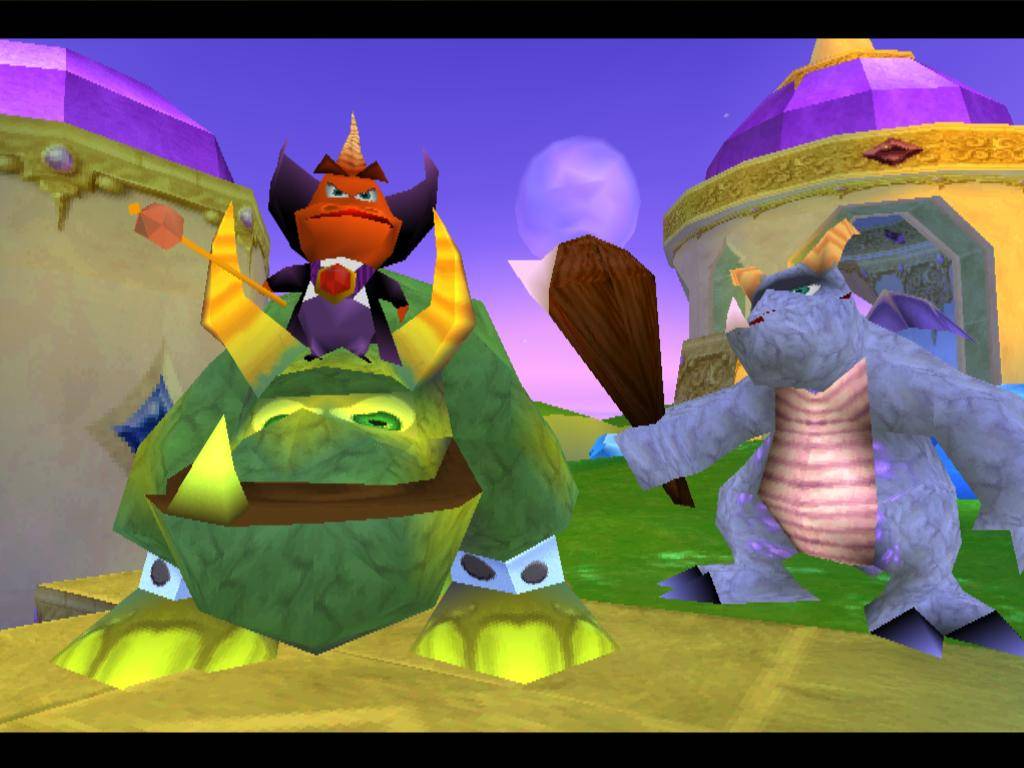
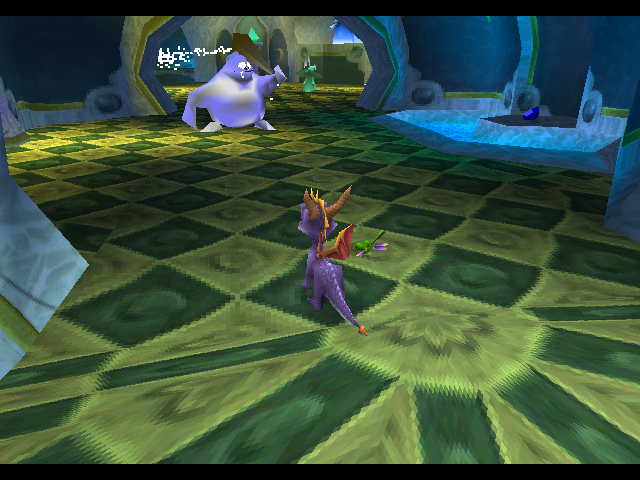
He's not convincing... Until he stands on top of
Gulp's head. 

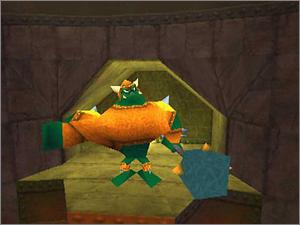
Outside of the Dragon World is a world called Avalar. It has been taken over by the evil Ripto, a puny little villain who has quite the temper. He doesn’t have much depth, but he’s certainly a far more interesting villain than Gnasty Gnorc. Why is that? Because there are cutscenes and he is present in a lot of them, plus he seems to have more a personality than the first game’s big brute. He’s the typical ridiculously foppish villain with his size, his big horn on his head and his flashy cape. His temper also makes him a pretty comical villain, especially when he deals with his dimwitted brutish beasts – Crush and Gulp.

Who lives in Avalar? Not dragons, but rather fairies, animals, fauns and all kinds of things. It’s certainly a lot more diverse than the Dragon World, that’s for sure. In the opening cutscenes, we are introduced to the other main characters: The Professor, Hunter and Elora. The Professor is a little mole who is of course the brains of the cast. Hunter is an athletic but often dim-witted cheetah, but he’s a lot of fun. Elora is a quiet faun who is no damsel-in-distress; she’ll help you along the way alongside Hunter. She kind of lacks a good personality; first she has something of an attitude but is generally a lot nicer later on in the game. There’s also a fairy named Zoe who will remind you of certain things like the dragons did in the first game; she also saves your progress when you complete a level, a mission or whenever you walk through an area that she’s in. Oh, and as for the voice acting... Well it’s nothing special. Some of it is very reminiscent of the cheesy kids shows you saw on TV in the 90s. Let’s just leave it at that, but there are some genuinely amusing and funny moments sprinkled in the writing.

"Uh, Hunter... The Professor's trippin' again."

So where does Spyro come in? Ripto drops the fact that he despises dragons, which leads the Professor to seek out a dragon. With his wits, he goes to a world called Glimmer and tools a portal. In the Dragon World, Spyro tells Sparx that he can’t stand the miserable weather. He decides to take a vacation to the sunny Dragon Shores (a level that just seemed to come out of nowhere), but due to the work of the Professor, he ends up in Glimmer instead. Little by little, he learns what he needs to do before he can get to his paradise.

Already, the story is stronger than the nonexistent one in the first game. Spyro now has characters he can interact with, ones that don’t stand a chance against our villains. In the first game, all you had was dragons and fairies... The dragons could easily torch Gnasty, so the developers had them disappear when you released them. The fairies? What can they do? Spyro 2’s team made the right decision with having a cast of animals that are not much bigger than Spyro, but they aren’t entirely weak. The story just makes more sense because of this.

Ummm... Lizard... I wouldn't laugh if I were you...

One downfall is that the other characters aren’t as well developed. Spyro is still a bit impatient like he was in the first game, but he seems to have matured since his first big adventure. The Professor, Hunter and Elora seem to lack in this department. The Professor is essentially the smart one, Hunter is the brawns and Elora is a “take charge” type but isn’t a cliché. Likewise, Ripto isn’t the best villain out there but he’s still better than Gnasty Gnorc. The story is standard, but enough to support the entirety of the game.

So Spyro 2 has a better story than its predecessor. It’s not perfect, but it’s serviceable. It’s on par with the storylines in the Crash Bandicoot games. But this story works because now, every level and home world doesn’t feel as lonely as the levels in Spyro. Free a dragon, torch some enemies... That world is now empty. But in the various levels of Spyro 2, there are locals. In the first level in the Summer Forest home world, Glimmer, there are kanga rats in the different areas. Zoe will be there to save your progress and you’ll occasionally run into Hunter or Moneybags in other levels.


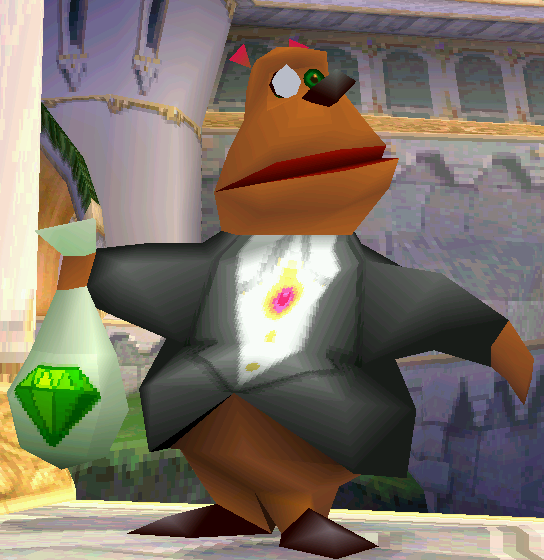
Who is Moneybags? If anything, he was the character that you wanted to torch. He’s a plump bear in a black waistcoat (nice little jab at fat cats there, Insomniac!) that only cares about one thing: Gems! Precious gems! You have to pay up when it comes to certain things. Moneybags will teach you things such as swimming, ladder climbing and head bashing. These new abilities add more to the gameplay, Spyro the Dragon could’ve used something like that. At other times, you have to pay him to unlock levels or activate something like an elevator or a bridge. Yes, he’s a pain.

So now onto the gameplay... What an improvement...

You have all your basic abilities from the first game, and the two power ups (supercharge and superflame) also reappear. The developers also added the “hover”, where you can pick yourself up in the air after gliding in order to reach a tricky height. It makes things a little less frustrating, especially if you had problems reaching certain areas in the first game.

In Spyro the Dragon, the objectives were simple: Go into a level, free dragons, get all the treasure and occasionally catch a thief with a dragon’s egg. Those basic tasks are back, minus the egg bits since you’re not in the Dragon World. It’s not that simple though.

This time around, gems don’t come from defeated enemies. Instead, you get shiny star-like orbs. Get enough and you can unlock a power up: Supercharge and superflame from the first game return. Then you also have flight and invincibility. A timer will appear each time you collect the power up, which you have to obtain by going between two spires that show your power up. What’s great about this is that you can now fly on certain levels, rather than just the Flight levels. It also adds even more variety to the game.

Summer Forest.

Now the objective of each level (up until the third home world) is to obtain a talisman. You’ll get it once you get to a certain point in the level, then the portal that’ll take you home appears. Each level has its own little storyline, and cutscenes play when you enter and exit for the first time. Usually the objective is to solve a problem that the locals are having, and then they’ll give you the talisman. You need to collect them all, of course!

But that’s not the end of it. There are also other things you have to do. The first of which is collecting orbs, emerald green spheres with golden rings, which are very powerful and are the reason why the Professor was able to get Spyro to Avalar. The orbs were scattered after Ripto invaded so he couldn’t find them, so now it’s up to Spyro to get them all. Orbs are given to you when you complete tasks for others.

There are many different tasks that add to the fun. In some tasks, you have save one or more locals. In others tasks, you will have to do something for them or the town. You get a good taste of this in the first level alone (Glimmer), whether it’s helping kanga rats advance to a certain location or helping them do something, such as lighting up lamps or shooting pesky lizards... Things they can’t do.

As you progress through the game, the different tasks get more challenging and fun. Others can be frustrating, but at least that makes a game a bit longer and less easy. Some frustrating missions involve escorting characters to areas without accidentally letting them get hurt... This can get annoying because the creatures you have to protect walk in erratic directions... Almost is if they want to get hurt. But I still welcome these kinds of missions because they make the game longer.

Again, that’s the problem I had with the first Spyro. Without missions like that, it just felt a little too easy and not as challenging. At other times, you can find orbs in hidden locations in different areas. This addition to the game really makes for an improvement, because it gives you more to do than just defeating enemies and collecting treasure.

The gameplay, in short, is a big improvement.

The individual levels are fun, big and loaded with different passages and secret areas. The design is great, but what’s different about this game is that none of the levels are based on the home worlds they are located in. Instead, each level takes on a totally different theme. In the first home world, Summer Forest, you’ll already see how different each level is. The dark and mechanic Hurricos is certainly nothing like the bright and colorful Sunny Beach, nor is the underwater techno-Atlantean Aquaria Tower anything like the Himalayas-inspired Colossus. But some levels do share some similarities: The inhabitants of Idol Springs and Colossus are very similar in design. In Autumn Plains, Skelo’s Badlands and Crystal Glaciers have locals that are pretty much the same humanoid species.

The goat is probably thinking, "... The hell is he
doing?"

Once you get to Autumn Plains, the quality of the level design and gameplay improves vastly. You’ll even see that two realms are at war with each other! That’s right, the developers really tried to add some interesting backstories to the different levels you go to. In Autumn Plains’ case, it’s Zephyr and Breeze Harbor. Zephyr’s blob-like land blubber creatures are at odd ends with the avian “breeze builders” from Breeze Harbor. It’s interesting how you take both sides in each level.

And some of the characters in the levels make for some comedic moments in cutscenes. In Shady Oasis, the hippos become huge when they consume berries. You need this to break through doors and gates. In the level’s closing cutscene, there’s a humorous bit where the hippos look for missing berries – cut to the big one trying to hide the berry that he’s eating while tons of others are around him. It’s actually kind of amusing. Sometimes the humor borders on a darker side... In a way. It’s kind of weird, really.

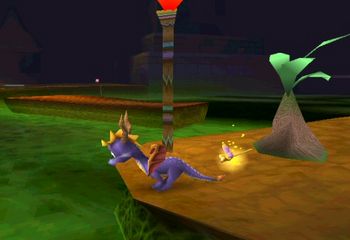
Take Magma Cone for instance. The little faun creatures are partying, and one just nonchalantly pushes another one into the boiling lava below... They continue partying. That’s kind of dark, don’t you think? Well, I still get a kick out of it because it’s in a family-oriented game. Other cutscenes are unexpectedly funny. At the end of Idol Springs, we see the locals roasting things at a campfire. An evil idol shows up, you think it’s going to eat everyone... Nope, it just happily roasts a sausage with them!

I guess that idol just simply gave up being evil...

At least the writers tried to punch these things up a bit. It’s certainly more interesting than seeing dragons being freed and hearing “Thank you for releasing me!” for the umpteenth time. (Though I will admit, some dragons have, sometimes unintentionally, funny moments) Good stuff. Sometimes the creatures you meet in different levels have something funny to say. They at least have some sort of personality and it only makes the worlds they live in much more interesting. Again, all good...

Once you get the third home world – Winter Tundra – things get a little different. Collecting a talisman in each level is out of the question, now you just have to muster up enough orbs to get into Ripto’s Arena and fight him.

What’s also different is that you have to backtrack this time around. In the first game, you could just collect everything in each level you went to. But since there are abilities that you can only learn later on in the game, there are some things you can’t do nor can you complete in a level. A good example is Glimmer, which has a section you can only reach by climbing a ladder. Moneybags teaches you how to climb ladders when you get to Autumn Plains, so... You have to go back.

It makes it more fun in a way, because you can revisit those worlds even if you completed a good portion of them. If you’re the kind to just get every talisman and just fight the bosses, then you have a lot of work to do. That could also be more fun, because if you get 100% on almost every other level... Then there are only a few to revisit.

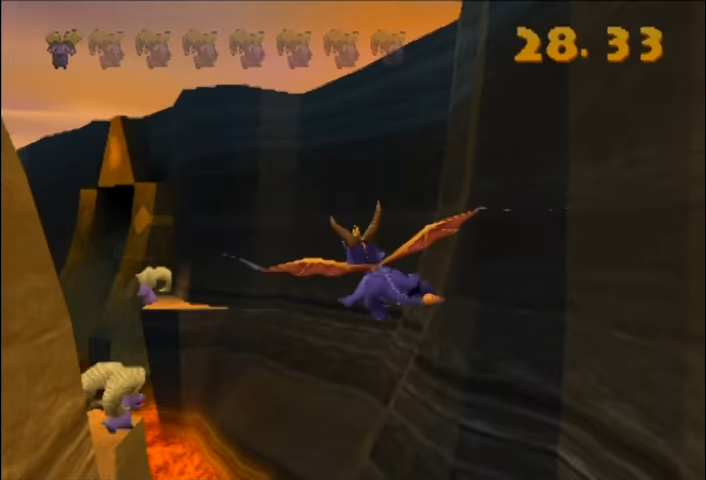
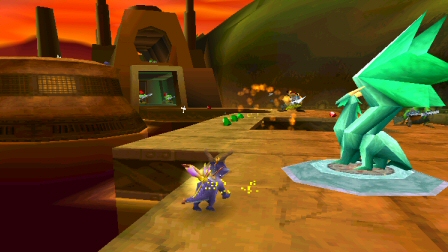
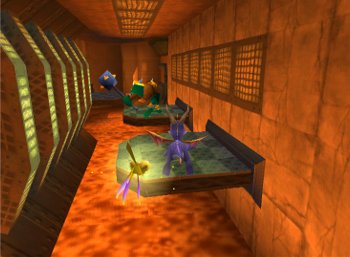
Canyon Speedway. Just like the Grand Canyon, but...
With lava!

Flight levels are back, but this time they are called “Speedways”. I will say, they are much more fun than the Flight levels in the first game, which to me were the only downfall of the entire game. The timed challenges are essentially the same, but you don’t have to just fly in these levels. You can also run around and destroy land-based things in the challenges. You can still fly through things like rings and arches, but you can run around and charge things like racecars and snowmobiles. Oh, and it’s supercharge too! But that’s not the only thing you can do. There are also other challenges that Hunter has prepared for you, such as trying to keep with him while he flies around or paragliding through rings.

Boss battles are more fun and challenging too. Instead of simply finding your rival and doing a few things to take him down, you take them on like you do in the Crash Bandicoot games. All three of them (Ripto and his two beasts) have health bars and have some sort of pattern that you have to memorize in order to outwit them. Oh, and the final battle with Ripto? Far more exciting than the showdown with Gnasty Gnorc...

One letdown is the final level, Dragon Shores. It’s nothing like Gnasty’s Loot where you could collect tons of treasure or the final level in the next game. Here, you basically participate in some old-fashioned carnival challenges to win tokens. Win ten and you basically have beaten the game, you can unlock the Dragon Shores movie theater and watch cutscenes... Okay... I will admit, the rollercoaster is fun. Also, why are gnorcs of all things running this place? Were they survivors who happened to bury the hatchet? Or did the dragons simply punish them for everything that happened in the first game? I’m looking too much into this...

"He's gonna whack me with that cane! I'm sure of it!"

So yes, Spyro 2: Ripto’s Rage is big improvement over the original in terms of gameplay... I actually think that this is the best game of the series on those terms; it’s not only an upgrade from the original but it’s also a lot of fun. Some of the different challenges really add a lot and bring more to these different worlds then ever.

The level design? Great as usual, since the first game boasted great level design. The first game mostly had fairy tale-like settings with big castles, bright green grasslands and mountains. Sometimes there would be a surprise like the swampy Beast Makers world or the more ugly seaport-like Gnorc Gnexus, in addition to some deserts and icy worlds.

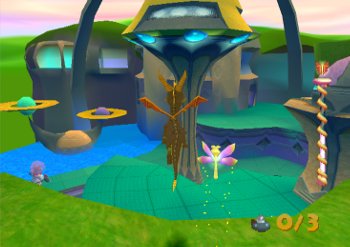
Here, there are all different kinds of places. All the levels are different and unique; they all have colorful inhabitants and enemies, and then some. A few levels hark back to the style of the first game, which is welcome. Something like Breeze Harbor or Hurricos reminded me of some levels. But then you have something like Zephyr, Skelo’s Badlands or Scorch that are certainly different. There’s a diverse selection of themes for the levels: Deserts, grasslands, mountains, temples, bogs, beaches and many other things. Towards the end of the game, you’ll come across some pretty creative levels such as Robotica Farms and Metropolis, two levels who are in a feud. While we did have a robot for a boss in the first game (Metalhead), we actually have a whole farm run by robots! Then there’s Metropolis, a futuristic inside a huge dome-like structure. Cool stuff! Since the two are at war, there are some surprises thrown in such as sheep in flying saucers hell-bent on wreaking havoc! How is that not awesome?


Now with great level design, you need fitting music. Spyro 2, like its predecessor, has ex-Police drummer Stewart Copeland on board. His music once again fits the atmosphere of each level, but retains a classic Spyro feel. He tries out new styles, but some levels do have the instruments and sound that defined a lot of the first game’s levels. Almost all of the tracks are great, some of them do get a bit repetitive. (Magma Cone’s music kind of annoys me, particularly that “Aum nuau!” sound effect that sounds like a grumbly “Aw no!”) I still put the soundtrack on par with the original; it combines the first game with an all-new sound and feel that just works so well. I can’t praise it enough.

~

So all in all, you have a game that is longer and more challenging than its predecessor. You get some new abilities, the design of the game is a lot different, and there's more to do. The design is also creative much like the first game, and there music goes perfectly with all of it. Spyro 2: Ripto's Rage is still fun to this day because of all this. The variety of missions, the main gameplay and several other things make it more than a classic. It's one of the quintessential PlayStation platformer games.

In part three, I'll finish things off with the third installment in the series - Spyro: Year of the Dragon!

All gameplay images are courtesy of the uploaders on the Spyro Wiki and GameFAQs!

Monday, March 18, 2013

PSone Nostalgia: "Spyro the Dragon" (Part 1)


Looks like PSone Nostalgia (tentative title, mind you) is back! Last December, I kicked off the series with a review of the three Test Drive games for the PlayStation - now I'll look at a trilogy that was one of the best in the console's history...

My favorite genre of gaming growing up was fantasy-based platformers. The likes of Super Mario 64 and Crash Bandicoot appealed to me. I loved point A to point B games where you had to take on a villain on at the end or follow a linear plot. To me, they were like super-long films but in interactive form. Not to mention, I preferred films with fantasy settings, mainly animated ones. Games like that were my thing.


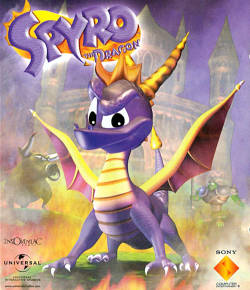
Like many 90s kids, I grew up with the great PlayStation trilogy that was Insomniac’s Spyro the Dragon. A great blend of fantasy, action-adventure and some comedy; it was a great example of what a family-friendly adventure game should be. Its gameplay is dotted with puzzles and challenges, while also trying to mix other things in. Sometimes successfully, sometimes not so successfully...

As a kid, I always favored the first game while still loving its sequels: Spyro 2: Ripto’s Rage (known as Spyro 2: Gateway to Glimmer in Europe) and Spyro: Year of the Dragon. Something about the first game really struck a chord with me; I think it was the overall atmosphere and the music... The sequels are very different in those two departments, and looking back on it, it’s for the better. Crash Bandicoot, the sort of “older brother series”, was no different. The first game differs significantly from its sequel, and that sequel is pretty different from the third one.


Spyro the Dragon’s plot is pretty simple: An evil villain named Gnasty Gnorc used to be a threat to the Dragon Kingdom, but now he’s isolated on a remote island. After a dragon mentions that he is ugly, he uses his club-like scepter to trap them all in a crystal. He misses Spyro, which means that the young dragon must free all of his older brethren. It does raise a few questions... Why is Spyro the only young dragon? Why are all the dragons male? Why are the dragons being interviewed by what seem to be people? Is this serious? Or is this some kind of irreverent game that gladly breaks the fourth wall? Was it just the developers poking fun at the game itself similar to the outtakes on some of the earlier Pixar films? Who knows; that shtick was cut for the sequels though.


Gnasty also turns all of the treasure of the Dragon World into minions, mostly the “gnorcs”, which are really humanoid troll-like things. There isn’t much depth to the story, Gnasty is the stock evil villain with not much background. Spyro doesn’t have much of a personality either, aside from the occasional sarcasm and whininess. He’s a little upstart that’s too interested in toasting Gnasty Gnorc, instead of focusing on what lies ahead on his long journey through the different realms of the dragon’s world. He doesn’t seem to show much development, it also doesn’t help that there aren’t many cutscenes. Whenever Spyro frees a dragon, there will be a brief conversation, but it’s either hints, jokes or a rather redundant “Thank you for releasing me!”

Yes, the game’s story is very minimal. It’s way too basic, and I’m fairly certain that Insomniac realized this. As result, they tried harder with the story and characters in the next two games. So if the story isn’t all that great, what is so good about this game?

Well the gameplay is very solid, the graphics were marvelous for their time... But best of all, it’s a very pretty game to look at. All of the different worlds have a distinct look and feel, but what I like about the design is that it perfectly captures a sort of fairy tale-esque atmosphere. From floating castles to colorful rooms built into hills and mountains, it’s just great to look at. Even today. A lot of imagination was breathed into the game. It’s just a bit of a shame that the story is so non-existent, this could’ve had a very compelling story.

However, it’s hard to pick at the game because of this since it is the first installment in the trilogy. After all, the first Crash Bandicoot game’s story is minimal, it’s very point A to point B. The two sequels don’t have much of a story either, since the titular character is a mute and the rarely seen sister speaks or has a prominent role.

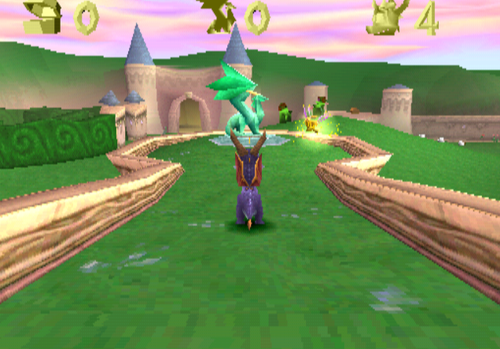
The Artisan home world.

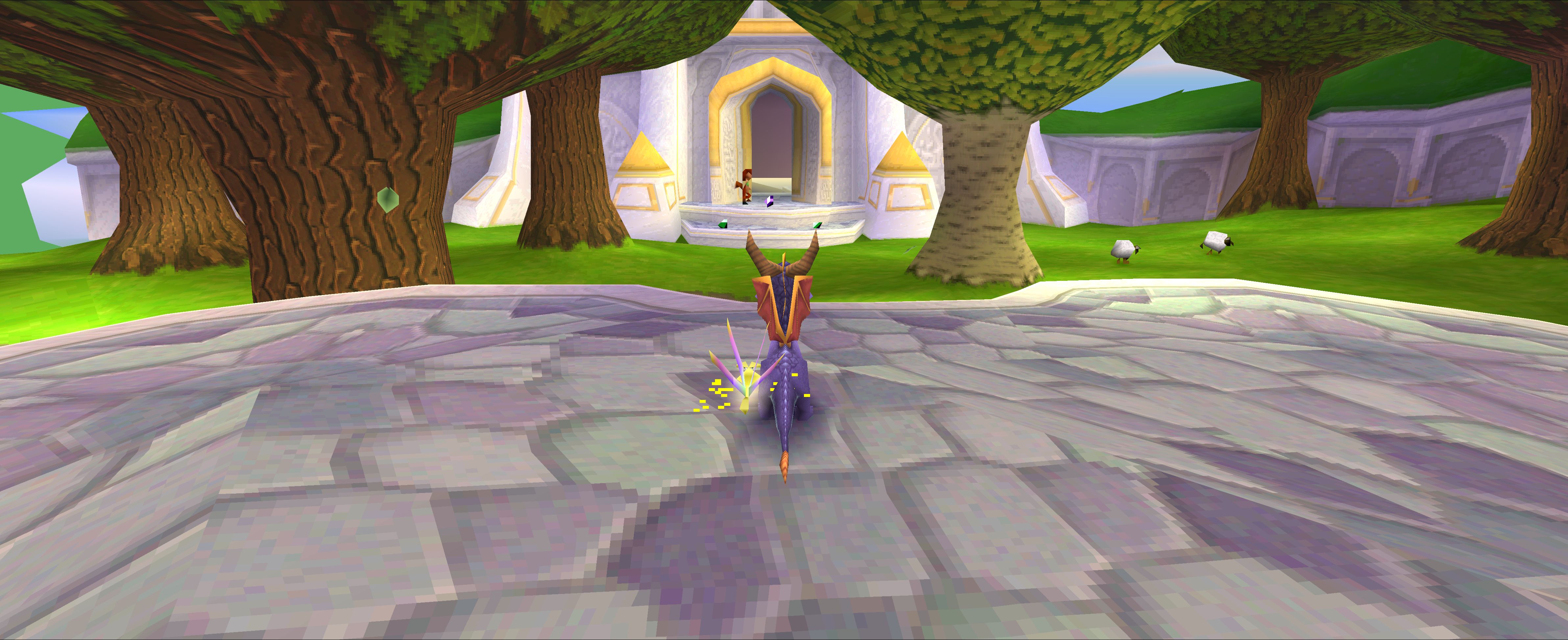
The game takes place in six different worlds that have at least four individual levels and a boss level. The first world is the Artisan World, which is essentially bright green grass and pretty castles. Even a level like Dark Hollow is lighthearted, it’s all kinds of nice. Stone Hill and Sunny Flight stick with the theme, but Town Square goes for an old world Spain atmosphere with its cobblestone paths, enemy bulls and gnorc bullfighters. Then you get to Toasty, the stage that’s the home of the titular boss. It looks like a hellish version of the Artisan Home, with its darker red/orange color scheme.

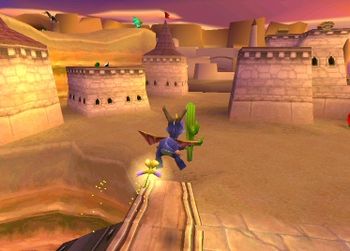
Cliff Town.

The second world is much tougher, the Peace Keepers World. It’s very militaristic, and it’s mostly deserts, save for the cold and barren Icy Cavern. In the home level, gnorcs carry weapons, only to run from you. They use canons, and you can use them too. Dry Canyon and Cliff Town repeat this theme, Night Flight is far removed from the theme. The boss here is Doctor Shemp, whose level is not desert-like but more like a combination between a canyon and grasslands.

Wizard Peak.

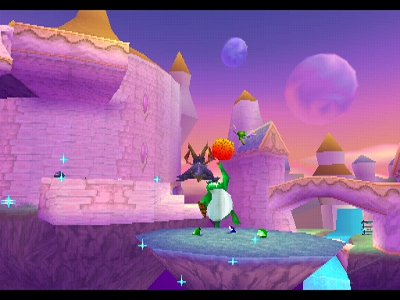
The Magic Crafter’s World, the third world, is closer in style to the Artisan Home with its lighthearted aura and heavy focus on... You guessed it, magic. Witchcraft, druids making things move, villainous wizards. All that good stuff. Lots of nice-looking castles and architecture define this world, but unlike the Artisan World, there are lots and lots of heights. Alpine Ridge and High Cliffs take the cake here.

Beast Makers home world.

My favorite of the worlds is the fourth one, the Beast Makers world. A very mucky, muted swamp-like world that’s far removed from the whimsical nature of the Artisan and Magic Crafter’s Worlds, the Beast Makers world is the darkest of the worlds. Some levels here have ominous low-key music and a rather creepy atmosphere, while most are loaded with bizarre enemies.

Lofty Castle.

The fifth world is the Dream Weaver’s World, which is once again similar to the Artisan and Magic Crafters worlds, but with unpredictable enemies and lots of new challenges. Design-wise, it isn’t too different from a lot of the previous levels we go through up until this point. Like its name implies, it's suitably dreamy and mostly airy. Look no further than Lofty Castle and Haunted Towers.

Twilight Harbor.

Gnasty’s World is the final world. Called the “Gnorc Gnexus” in the game, it’s ugly, metallic and cold. Gnorcs use explosives and machine guns instead of regular weapons. These guys mean business now that you’re in the final stretch.

To wrap it up, the design is great and it still looks wonderful to this day. So, the gameplay...

Spyro is no different from platformers of the time: You collect things and finish open-ended levels. Spyro’s objective is to free the dragons that have been trapped in crystal and to collect all the treasure. Treasure can be found scattered around, many times in chests, boxes of explosives (flame them and stand clear!), strange fan-like propeller pods, or enemies. You also have to collect stolen dragon eggs, which are in the possession of pesky thieves dressed in blue that don’t attack you; you just have to chase them down. To move onto the next home world, you have to have a certain amount of treasure or you have to have freed a certain amount of dragons in order to be granted permission to pass. In every home world, a balloonist lets you go from world to world when you have met his requirements...

What's wrong with your eye there, Spyro?

By the way, what are the balloonists? Are they humans? Or some humanoid kind of thing? What else exists in this world besides dragons? Well you see fairies here and there, and you’ve got your protector dragonfly Sparx. His color indicates your health, and the more you get hit, the weaker he gets. Sparx collects the gems, but when he’s blue or green rather than gold, he doesn’t get the gems until you move closer to the treasure. You’re in trouble when you’re without him. How do you get him back? Fodder!

Every level has little creatures like sheep, hopping mushrooms, chickens, frogs, and rats... All kinds of small things that are harmless. Take them down and you’ll get butterflies, which Sparx eats to get stronger. You are always reminded of this thanks to certain dragons that you free, as they remind you of other little things in case you forget anything.

You have some moves, of course. When you were a kid in the 90s, chances are you were excited to see what you could do with a dragon as opposed to Mario, Sonic and Crash Bandicoot. You can charge your enemies with your horns, or toast them with your fire breathing. Some enemies can’t be charged, while others can’t be toasted (mostly due to armor or something). You can also glide to other areas, but you can’t fly except in the Flight levels. Each world, save for Gnasty’s World, has one. In these levels, you have to complete timed challenges by flying through things and flaming objects. For instance, in the Night Flight level, you fly through swirling rings, arches and then you flame treasure chests and lighthouses. Just watch out for the water.

That’s right, you can’t swim in this game. The sequels allow you to swim, so Spyro the Dragon is essentially the Grand Theft Auto III/Grand Theft Auto: Vice City of the original trilogy, and you are a bit limited here since many worlds are loaded with water or some kind of killer liquid that function like bottomless pits.

The Flight levels are simply the low point of the game; not because they are bad, but because they don’t really add much. Being able to fly does sound like fun, but since it’s only used for timed tasks, it’s a letdown. How come other levels couldn't have brief challenges where you had to fly in order to get something? Why did the developers opt for the same thing for each flight level instead of a different challenge where you didn't have to fly through things or flame objects?

Supercharge.

Aside from all the basic gameplay, what else can you do? There are power ups like supercharge and superflame. In order to do a supercharge, you have to find a path with arrows that light up. That way, you run so fast that your feet move like wheels; points for the chugging noise when you do so. Superflame is given to you (in certain levels, of course) by red fairies when they give you a kiss, and then your flame can take out anything. It’s very useful in levels like High Caves and Haunted Towers where there’s enemies that you can’t charge or flame.

You have a nice variety of abilities, but not too much. It’s a decent amount for a platformer, especially for the first game, but there could be a bit more. Luckily the sequels expanded upon this, much like how Crash Bandicoot’s sequels tried new things.

But with a limited amount of things to do, why does this game work so well? Collecting treasure is satisfying, I mean, what’s better looking than multi-colored gems? Seriously, I loved collecting them. When you hit the jackpot, it’s also a lot of fun. It gives you that satisfied feeling, but then all that fun is gone once you’ve already gotten the gems. When you defeat enemies that you’ve defeated before, you get clear orbs. Collect enough and you’ll get another life. Lives are normally hidden in clamshells, and there are a good amount of them.

Dark Hollow.

Each level’s layout is fun to try out, and each has a set of challenges. For example, one level might have an area that you can only reach when you use the supercharge. Others have enemies that change, such as Dark Passage, where the darkness turns the small enemies into bigger ones. Dark Passage, along with some other levels, contain hidden areas that are fun to find and explore. Sometimes you’ll come across tricky heights, and at other times you’ll have to find way to destroy an armored treasure chest. It provides enough challenge for a game that’s this short.

If you want to simply be like Spyro and quickly get to the end of the game more than anything, you'll have to backtrack and collect gems that you have missed or free dragons that haven't been released. After you defeat Gnasty Gnorc, you need to have 100% completion in order to access the final level - Gnasty's Loot. However, I just collect everything before advancing to the next world; that way you can get to the loot after defeating the dastardly villain.

The only other problem with this game’s gameplay is that it’s a little too easy. The levels usually follow the same formula without mini-games, you simply free dragons, collect treasure and retrieve stolen dragon eggs. That can get a bit monotonous once you starting getting towards the end of the game. Boss battles aren’t much to write home about either. The boss battles are essential levels with a big enemy at the end. The only one I’d call a bit challenging is Metalhead. The rest are way too easy. Doctor Shemp is essentially a bigger and stupider Papu Papu from Crash Bandicoot, though his frantic running after you flame him is hilarious. Toasty? Flame him three times and you’re good. Blowhard? More of the same; just avoid his rather pitiful attacks. Jacques? Just chase him without falling and getting hit by his boxes. Gnasty Gnorc? Again, chase him and flame him. There’s not much of a challenge, here.

If there’s one more thing to praise, it’s the soundtrack. Stewart Copeland, the drummer from The Police, provided the music for the whole trilogy. Spyro the Dragon’s music is a mix of pure fantasy and rock music elements. The two styles mix perfectly. Each level has a great track; whether it’s the soaring, magical tone of the Dream Weaver’s levels to the murky and spooky vibe of the Beast Maker’s levels. Copeland often mixes rock guitars into the songs, without having them seem out of place. Other levels even hint at jazz and world music... It’s just the perfect mix, and if you ask me, this game boasts the best soundtrack out of the whole trilogy.

That’s not to say the other two games have highly inferior soundtracks, but this one is very special. It nails the setting completely, even if the story and gameplay may not add up in the long run. I could probably dedicate a whole blog post to this soundtrack, but to be to blunt – it’s just all-around wonderful. It’s all kinds of good, and each track just works so well its respective level.

Going after Gnasty Gnorc.

I used to favor this game over the two sequels mostly because of the design and the music. They certainly are the game’s strongest points and they really make the game stand out, but looking back on it, a much stronger story would’ve gone perfectly with these visuals. The game has a sort of lonely feel because of the minimal dialogue. There’s not much else in this world outside of the dragons... The fairies don’t speak to you, and when your enemies have been defeated, all you have left is the fodder creatures. Nothing lives inside of the smaller buildings and castles that the dragons obviously can’t fit into, there’s no sense of... Community. Unless Gnasty has a lot of innocent beings locked up, we don’t see anything else besides dragons. Also, the dragons simply disappear after you have freed them.

That brings up another question. Why do the dragons disappear after you free them? They can’t help Spyro because that would be too easy. However, when you get to Gnasty’s World, you’ll free some dragons that you’ve already released. Did they attempt to stop him only for Gnasty to crystallize them again? How come Gnasty didn’t freeze Spyro? Did he simply miss him or does he want to mess with him? I know I might be dissecting what is essentially a harmless family-friendly game, but the sequels seemed a lot more logical when it came to this kind of thing.

I may seem a bit harsh on this game, but I actually love it. Despite its flaws, I can’t resist it. Easy as it is, I still enjoy playing the whole game from start to finish. It’s a fun experience, and it may not provide too much of a challenge, but these worlds are great to explore and the music is a treat. Some of the more challenging parts of the game are certainly fun to try, such as using supercharge on levels like Tree Tops and Haunted Towers; or finding hidden areas in other levels.

This also may sound a bit crazy, but I’d love to see Insomniac revisit the first game and remake it with a bigger story, more interactions with different characters and perhaps bosses that are far more challenging. Maybe they can also expand the levels and make them bigger, but still keeping the overall design and feel. Oh, and keep the original music and try to stay true to the feel of the original. I'd actually like to see that happen one day.

~

Spyro the Dragon was a fabulous game for its time and it’s still good fun today. If its gameplay and story don’t hold up too well in some areas, then it’s the great look and sound of it that does. It’s a true PlayStation classic.

In part two, I’ll look at its sequel - Spyro 2: Ripto’s Rage!

All gameplay images are courtesy of the uploaders on the Spyro Wiki!