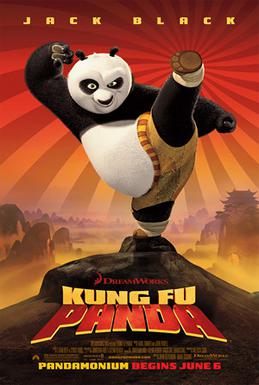
At the beginning, we get the idea that Po (voiced by a rather unexcited Jack Black) wants to be like the Furious Five, the master kung fu warriors of China. He lives in the Valley of Peace, where he works for his father, a goose named Mr. Ping (voiced by James Hong). Mr. Ping is very one-way, and believes that Po's place in life is just working at the noodle restaurant. Po does get his dream, but he's still lazy and can't master kung fu to save his life. A terrifying villain locked up miles away breaks out of a highly secure prison, and now the panda has to take things seriously. He basically learns kung fu by trying to get a dumpling from Master Shifu in a pretty fun sequence.
This is good and all if you're doing a kung fu spoof, but halfway through its 90-minute runtime,
Kung Fu Panda tries to take itself a little more seriously than what it really is. It's very hard to take it that way, but it's admirable because the writers are at least trying. We are presented with a pretty big conflict. Enter our villain, Tai Lung (voiced by Ian McShane), a powerful snow leopard. When we first see him, he comes off as a pretty threatening character. Then we learn why he's there and why he's a threat, it's all well-told. When he escapes from a heavily guarded prison, it gets pretty intriguing.
There are some attempts at heart that fall flat. Master Oogway's passing seems like it was shoe-horned into the story for the sake of having a tearjerker moment, and as beautifully done as the scene was, it was pretty overblown. Tai Lung's backstory doesn't strike much of an emotional chord either, though at least it gives us a reason why the leopard is evil. With that said, the characters are likable for the most part. The only ones that were really strong were Master Shifu and Tai Lung. The Furious Five seem like stock characters, though they are fun at times. Out of all of them, Tigress (voiced by a rather uninterested Angelina Jolie) is the most interesting, being a very cold character who has a good reason to be so.
Kung Fu Panda's decent story is actually the backbone to the action and the visuals. It's not ashamed of being a plain good action film, with kung fu scenes that are directed with a lot of energy. Already doing what a camera can't achieve, the animators still put in some extra effort and spice the fight scenes up with fun and occasional cleverness. The final fight scene between Po and Tai Lung is also fun, despite being a bit overlong.
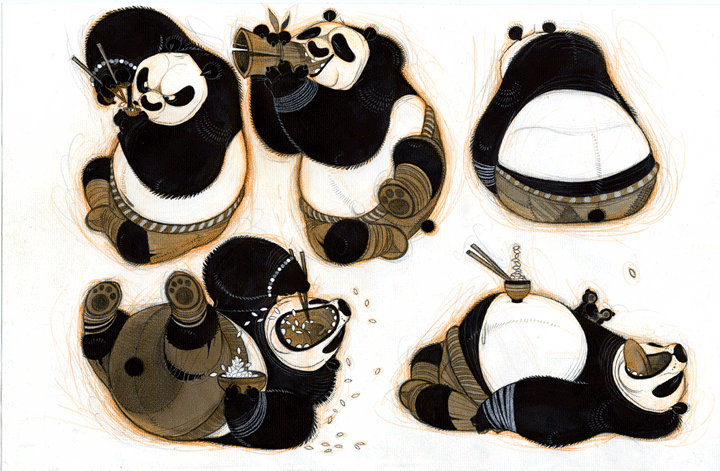
The film's greatest strength is the animation. For the first time, DreamWorks experiments with character designs that wouldn't be out of place in a Pixar film. The only design that didn't cut it was Po's design, as it tries to keep that DreamWorks' style, and it doesn't help that Jack Black's performance isn't very good either. Tai Lung is appropriately menacing and colorful at the same time, in fact the whole cast of characters is very colorful. They're more appealing than what we saw in the previous films. The art direction is brilliant, capturing the look of Ancient China with a fantastic color scheme and an effective score by Hans Zimmer and John Powell to match it.
The film's best visuals are done in traditional animation, like the aforementioned opening sequence. It's innovative, and at the same time, it's not distracting. It's basically folk art meets
Samurai Jack, and it's a feast for the eyes. It's similar to Disney's animation changes in their films. This style is even incorporated into a sequence towards the end of the film, adding an extra punch. The set design is lovely, giving the film a very "epic" feel, given that most of the film takes place on mountains and cliffs. Everything is done right, and the Chinese art and architecture influences aren't wasted on the typical designs. The characters, even the extras, boast very strong designs.
When watching this, one can tell that the animators and the story team really wanted to make something memorable with this film. One that would entertain both children and adults without ever seeming forced, but the story isn't the strongest and at times it's a bit contrived. The screenplay is pedestrian as far as animated films go, as it still feels the need to bombard us with forced jokes and modern slang dialogue. At least the film aims to be a comedy early on, and if taken as an action-comedy,
Kung Fu Panda is a winner. It's got really fun action that you're not going to get in a big budget live action blockbuster (since most of those films are bad anyways) and lovely artwork to boot, but story wise, it feels like the studio is testing the waters to see if they can go forward with storytelling like this.
B-~
Madagascar: Escape 2 Africa
Directed by Eric Darnell and Tom McGrath
Written by Etan Cohen, Eric Darnell and Tom McGrath
Produced by Mireille Soria
Released on November 7, 2008
Everyone knew a sequel to Madagascar was inevitable. For starters, Madagascar happened to debut during the computer animation boom, before tons of computer animated films came about and made audiences weary of what films to see and which turkeys to avoid. Madagascar was no turkey, it was a fun film that only suffered from pacing and an annoying screenplay that didn't seem to keep quiet. It had very unique animation that was the antithesis of Pixar's style, being rooted more in a cartoon fashion than anything with some zany designs. On top of that, it was just plain fun and it ended with a sequel hook, as if DreamWorks knew from the start that this would be a grand slam at the box office.
It was, so alas we get Madagascar: Escape 2 Africa (lame title, but the working title was even worse, The Crate Escape!), where the zoo animals attempt to fly back to New York with a makeshift airplane that crash-lands in the middle of Africa's savannas. They get entangled in a situation where an obviously power-hungry lion is plotting against the home where Alex's parents are from, going a slight Lion King route. Alex humiliates his parents, and at the same time Marty, Melman and Gloria find a lot to love in this new environment.
Madagascar: Escape 2 Africa's biggest problem is that the story doesn't seem to go anywhere, despite the unexpected attempts at developing the four friends. There's pseudo-emotional fluff such as a scene where Alex can't tell which zebra Marty is, leading to this pointless scene where they quit being friends. Criticizing these scenes in what should be a fun comedy should be pointless, but these scenes were what hurt Madagascar (Alex wanting to eat Marty) and they hurt this film too. If DreamWorks wanted to make an all-out fun comedy with a good story, then that's what they should have done instead of trying to force these elements into the film.
Melman and Gloria's scenes are also forgettable and almost pointless, and their "romance" (if you want to call it that) is just plain unnecessary. The new characters aren't very interesting either. The lemurs and the penguins steal the show once again, as King Julien is absolutely hilarious. The penguins mess around with the monkeys trying to fix the plane. In order to pad the film out even more, we get scenes with a bunch of New Yorkers on safari. These characters aren't very necessary, only giving the writers an excuse to put the feisty old lady from the first film in the story. The old lady was funny in Madagascar because it was a quick scene, and one that came out of nowhere, plus the idea of an old lady beating up a lion was pretty funny. Here, all the humor is sucked out of it. It's like killing a good joke. That being said, the antics that ensue in the film's third act are quite funny.
With all these flaws, you'd expect Madagascar: Escape 2 Africa to be an outright failure. It isn't. It's no worse than its predecessor, but it dials down the fun in an attempt to tell a story. It's both a strength in a way and a big weakness, it's hard to say because this is quite frankly the most bizarre film DreamWorks has released to date. It's one that really has a hard time picking a tone, and oddly, it somewhat succeeds despite its flaws. It's fun at times, it's got some hilarious scenes and it's entertaining. The story is better than the first film's, but the screenplay isn't. It's a weird sequel, and one that doesn't go the route of Shrek 2 and Shrek the Third, which is very fortunate. It's just an entertaining diversion much like its predecessor, but it isn't as inviting.
C
~
Critical and Commercial
It's very obvious that Kung Fu Panda was the more creative, artistic effort out of these two films. Madagascar: Escape 2 Africa would be the obligation and one that would function as the bread and butter film. That said, perhaps the reception of the previous DreamWorks was what motivated the team to put effort into Kung Fu Panda. Early on in production, this was aiming to be just like Shrek 2. It would've been forgettable and crammed with humor that would make audiences cringe.

The early versions of this film were problematic. It was a kung fu spoof and Po was initially going to be an unlikable lead. Then the story team decided that this wasn't working, and at the same time, did some research. For the opening scene alone, they studied the folk art of China. The animation would be a lot more sophisticated, since they were working with a story that wasn't going to be anything like the ones in the previous films. It's obvious that their eyes weren't on a toy commercial, but something audiences would genuinely like.
The success of the film proved it. DreamWorks felt very confident in this film, releasing it mere weeks before Pixar's WALL-E. It received great reviews, becoming their most-acclaimed film since Shrek 2 and it opened with $60 million. With good word of mouth, it had no problem becoming the first DreamWorks animated film that wasn't a sequel to cross the $200 million mark and also do extremely well in home media sales. Worldwide, it was the highest grossing animated film of 2008 with $631 million. It served as a fun alternative to the science fiction epic that WALL-E was, which catered more to adults more than family audiences.
It was even up for Best Animated Feature. The last time a DreamWorks film got that nomination (not counting Aardman's Wallace and Gromit: The Curse of the Were-Rabbit) was in 2004, with Shrek 2 and Shark Tale. It took home every award at the Annie Awards, which caused a lot of controversy and rightfully so (I'll refrain from the "inside job" stories and my views on the whole Annies controversy). All of this aside, Kung Fu Panda was a deserved victory for the studio and one that proved to audiences and critics alike that they were willing to try harder.

Madagascar: Escape 2 Africa was the obvious financial success, but one that didn't necessarily attempt to just get by. It does have effort put into it, as critics took note. Critics were a bit more positive with the sequel, but audiences were left cold. Despite a $63 million opening weekend, it scored very poor word of mouth and limped its way to $180 million stateside. A November release date probably hurt it as well. Had DreamWorks scheduled it for the summer of 2009, to debut after Monsters Vs. Aliens (2009 was the only year since 2003 when DreamWorks Animation only had one film released) with a little more story polish, then it could've been more of a success.
It made less than its predecessor, but worldwide, it topped it with $603 million and even outgrossed WALL-E. That said, it wasn't up for Best Animated Feature. With that and an original film both clearing $600 million in one year, DreamWorks was all set for the endeavors that would follow. However, the road to improving was a bit longer than that of Disney's immediate uphill climb.
In part two, I'll take a look at Monsters vs. Aliens.